Question
There are certain benches in a classroom. If $4$ students sit on each bench, three benches are left vacant and if $3$ students sit on each bench, $3$ students are left standing. What is the total number of students in the class?

Answer

Let the number of students be $x$ and number of benches be $y.$
$(i)$ When $4$ students sit on one bench:
Number of benches occupied $= y - 3$
$\Rightarrow x = 4(y - 3) \dots......(i)$
$(ii)$When $3$ students sit on one bench:
$3$ student are left standing
$\Rightarrow x = 3 = 3y$
$\Rightarrow x = 3y + 3 \dots......(ii)$
From $(i)$ and $(ii)$
$4(y - 3) = 3y + 3$
$4y - 12 = 3y + 3$
$y = 15$
But $x = 4(y - 3) \dots...($from $(i))$
$\Rightarrow x = 4(15 - 3)$
$\Rightarrow x = 48$
Therefore, Number of students in the class $= 48.$

Need a full question paper?

Generate a complete, print-ready paper with questions like this in minutes — across 16+ boards, with answer keys.
Start Generating Free

Similar questions

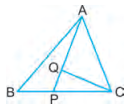
In the given figure, $P$ is a point on side $B C$ of $\triangle A B C$ such that $BP : PC =1: 2$ and Q is a point on AP such that $PQ : QA =2: 3$.
Show that ar $(\triangle AQC ): \operatorname{ar}(\triangle ABC )=2: 5$.
Image
The mean of $x, x+2, x+4, x+6$ and $x+8$ is $11,$ find the mean of the first three observations.
In $\tan \theta = 1$, find the value of $5\cot^2\theta + \sin^2\theta - 1$.
The distance between two places Bangalore and Hyderabad is $660 \ km.$ Anand starts from Bangalore with a certain uniform speed while Sonu starts from Hyderabad at the same time with a uniform speed that is $4\ km$ more than that of Anand. If they meet each other after $5$ hours, find the speed of each.
In an isosceles triangle, each of the two equal sides is $4 \ cm$ more than the base. If the perimeter of the triangle is $29 \ cm$, find the sides of the triangle.
In the following, the coordinates of the three vertices of a rectangle $\text{ABCD}$ are given. By plotting the given points; find, in case, the coordinates of the fourth vertex:$B (10, 4),C(0, 4)$ and $D(0, -2).$
If \sin $A =\frac{\sqrt{3}}{2}$ and $\cos B =\frac{\sqrt{3}}{2} ,$ find the value of $: \frac{\tan A-\tan B}{1+\tan A \tan B}$
Simplify by rationalising the denominator in the following.$\frac{4+\sqrt{8}}{4-\sqrt{8}}$
If $a b c=1$, prove that : $\frac{1}{1+a+b^{-1}}+\frac{1}{1+b+c^{-1}}+\frac{1}{1+c+a^{-1}}=1$.
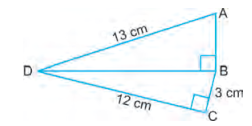
In the given figure, ABCD is a quadrilateral in which $BC =3 cm$, $AD =13 cm, DC =12 cm$ and $\angle ABD =$ $\angle BCD =90$. Calculate the length of AB .
Image