MCQ
There are certain material developed in laboratories which have a negative refractive index. A ray incident from air (medium $1$) into such a medium (medium $2$) shall follow a path given by

  • B

  • C

  • D

Answer

Correct option: A.

a
$sin\, i = msin\, r$
$r$ is negative

Need a full question paper?

Generate a complete, print-ready paper with questions like this in minutes — across 16+ boards, with answer keys.
Start Generating Free

Similar questions

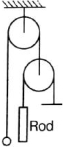
In the figure, mass of a ball is $\frac{9}{5}$ times mass of the rod. Length of rod is $1 \,m$. The level of ball is same as rod level. Find out time taken by the ball to reach at upper end of rod. (in $S$)
Potential energy as a function of $r$ is given by $U=\frac{ A }{ r ^{10}}-\frac{ B }{ r ^{5}}$, where $r$ is the interatomic distance, $A $ and $B$ are positive constants. The equilibrium distance between the two atoms will be
Dot product of two mutual perpendicular vector is
A constant voltage is applied between the two ends of a metallic wire. If both the length and the radius of the wire are doubled, the rate of heat developed in the wire
A slender rod of mass $M$ and length $L$ is hinged about an end to swing freely in a vertical plane. However, its density is nonuniform and varies linearly from hinged end to the free end doubling its value. The moment of inertia of the rod, about the rotation axis passing through the hinge point is
At what distance for a long straight wire carrying a current of $12\, A$ will the magnetic field be equal to $3 \times 10^{-5} Wb / m ^{2}$ ?
An achromatic combination of lenses produces
$A$ body kept on a smooth horizontal surface is pulled by a constant horizontal force applied at the top point of the body. If the body rolls purely on the surface, its shape can be : 
A projectile moving vertically upwards with a velocity of $200\, ms^{-1}$ breaks into two equal parts at a height of $490\, m$. One part starts moving vertically upwards with a velocity of $400\, ms^{-1}$. How much time it will take, after the break up with the other part to hit the ground? $ .............. \mathrm{s}$
An athlete throws a discus from rest to a final angular velocity of $15\, rad\, s^{-1}$ in $0.270\, s$ before releasing it. During acceleration, discus moves a circular arc of radius $0.810\, m$. Acceleration of discus before it is released is ....... $ms^{-2}$.