Question
There are energy bands in a solid. Do we have really continuous energy variation in a band or do we have very closely spaced but still discrete energy levels?

Answer

A solid consists of a combination of closely spaced energy levels. These energy levels are discrete but they have very small energy gap between two consecutive levels so they are referred as band. However, the energy levels in the band are discrete.

Need a full question paper?

Generate a complete, print-ready paper with questions like this in minutes — across 16+ boards, with answer keys.
Start Generating Free

Similar questions

In a hydrogen atom, the electron and proton are bound at a distance of about 0.53 $\mathring{\text{A}}$:
  1. Estimate the potential energy of the system in eV, taking the zero of the potential energy at infinite separation of the electron from proton.
  2. What is the minimum work required to free the electron, given that its kinetic energy in the orbit is half the magnitude of potential energy obtained in (a)?
  3. What are the answers to (a) and (b) above if the zero of potential energy is taken at 1.06 Å separation?
Let $\overrightarrow{\text{A}}$ and $\overrightarrow{\text{B}}$ be the two vectors of magnitude 10 unit each. If they are inclined to the X-axis at angles 30° and 60° respectively, find the resultant.

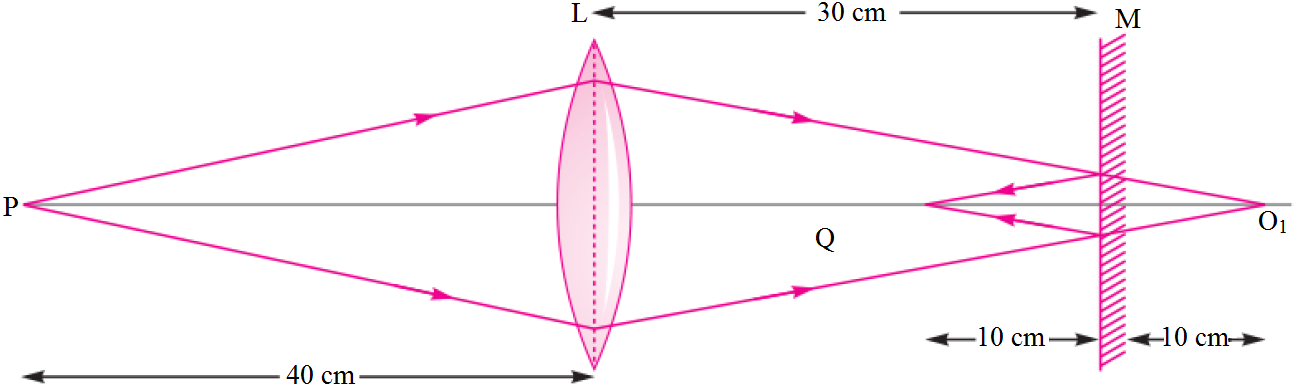
A convex lens, of focal length 20cm, has a point object placed on its principle axis at distance of 40cm from it. A plane mirror is placed 30cm behind the convex lens. Locate the position of image formed by this combination.
Is it easier to take out a nucleon from carbon or from iron? Fi-om iron or from lead?
The horizontal component of the earth's magnetic field at a certain place is $3.0 \times 10^{-5} T$ and the direction of the field is from the geographic south to the geographic north. A very long straight conductor is carrying a steady current of $1 A$. What is the force per unit length on it when it is placed on a horizontal table and the direction of the current is $(a)$ east to west; $(b)$ south to north?
Is $\text{p}=\frac{\text{E}}{\text{c}}$ valid for electrons?
If three helium nuclei combine to form a carbon nucleus, energy is liberated. Why can't helium nuclei combine on their own and minimise the energy?
  1. Define mutual inductance and write its S.I. unit.
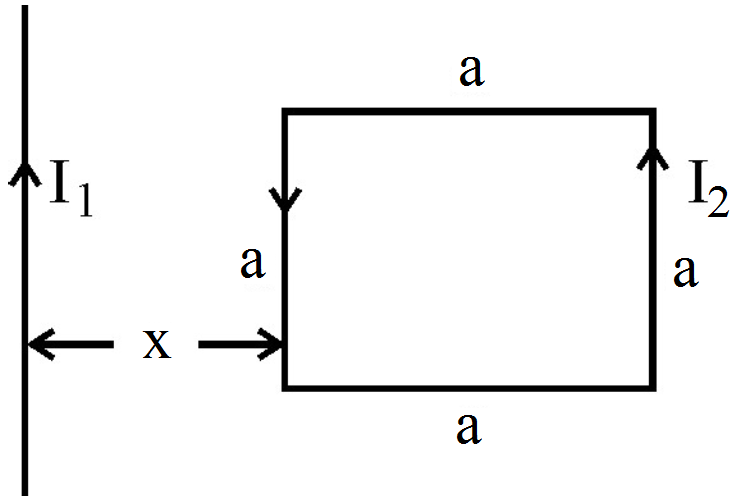
  2. A square loop of side ‘a’ carrying a current $I_2$ is kept at distance x from an infinitely long straight wire carrying a current $I_1$ as shown in the figure. Obtain the expression for the resultant force acting on the loop.
  1. Which segment of electromagnetic waves has highest frequency? How are these waves produced ? Give one use of these waves.
  2. Which em waves lie near the high-frequency end of visible part of em spectrum? Give its one use. In what way this component of light has harmful effects on humans?
A tunnel is dug along a chord of the earth at a perpendicular distance $\frac{\text{R}}{2}$ from the earth's centre. The wall of the tunnel may be assumed to be frictionless. Find the force exerted by the wall on a particle of mass m when it is at a distance x from the centre of the tunnel.