Question
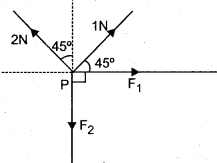
There are few forces acting at a Point P produced by strings as shown, which is at rest. Find the forces$F_1 \& F_1$ Image

Answer

Using Resolution of forces IN and $2 N$ and then applying laws of vector addition. Calculate for $F _1$ $\& F_1$.$F _1=\frac{1}{\sqrt{2}} N , F _2=\frac{3}{\sqrt{2}} N$

Need a full question paper?

Generate a complete, print-ready paper with questions like this in minutes — across 16+ boards, with answer keys.
Start Generating Free

Similar questions

A mass of ideal gas at pressure P is expanded isothermally to four times the original volume and then slowly compressed adiabatically to its original volume. Assuming γ(= CP/CV) to be 1.5, find the new pressure of the gas.
A flask is filled with 13g of an ideal gas at 27°C and its temperature is raised to 52°C. Find the mass of the gas that hias to be released to maintain the temperature of the gas in the flask at 52°C and the pressure is same as the initial pressure.
In lifting a $10\ kg$ weight to a height of $2\ m, 230\ J$ energy is spent. Calculate the acceleration with which it was raised.
Two discs of moments of inertia $I _1$ and $I _2$ about their respective axes (normal to the disc and passing through the center), and rotating with angular speed col and $\omega_2$ are brought into contact face to face with their axes of rotation coincident,
1. What is the angular speed of the two - disc system ?
2. Show that the kinetic energy of the combined system is less than the sum of the initial kinetic energies of the two discs. How do you account for this loss in energy ? Take $\omega_1 \neq \omega_2$.
A body of mass 0.3 kg is taken up an inclined plane to length 10 m and height 5 m and then allowed to slide down to the bottom again. The coefficient of friction between the body and the plane is 0.15. What is the
(i) work done by the gravitational force over the round trip?
(ii) work done by the applied force over the upward journey?
(iii) work done by frictional force over the round trip?
(iv) kinetic energy of the body at the end of the trip?
How is the answer to (iv) related to the first three answers?
By what percentage should the pressure of a given mass of a gas be increased so as to decrease its volume by 10% at a constant temperature?
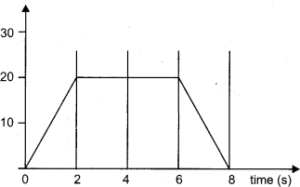
The velocity time graph for a particle is shown in figure. Draw acceleration time graph from it.
Image
A bullet of mass 0.02 kg is moving with a speed of 10 ms-1. It can penetrate 10 cm of a wooden block, and comes to rest. If the thickness of the target would be 6 cm only, find the K.E. of the bullet when it comes out.
The rear side of a truck is open and a box of $40 kg$ mass is placed $5 m$ away from the open end. The coefficient of friction between the box and the surface below it is 0.15 on a straight road, the truck starts from rest and accelerates with $2 m / s ^2$. At what distance from the starting point does the box fall off the truck? (ignore the size of the box)
Water is pumped out of a well 10 m deep by means of a pump rated 10 KW. Find the efficiency of the motor if 4200 kg of water is pumped out every minute. Take g = 10 m/s2.