Question
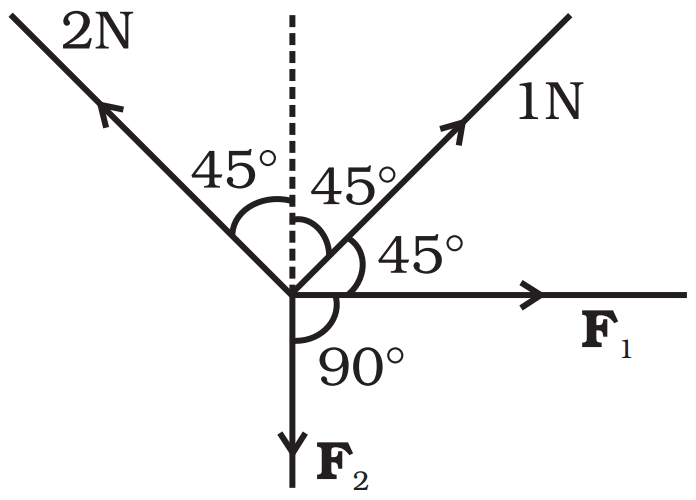
There are four forces acting at a point P produced by strings as shown in which is at rest. Find the forces $F_1$ and $F_2$.

Answer

As the particle is rest or a = 0. So resultant force due to all forces will be zero.$\therefore$ Net components along X and Y-axis will be zero.
Resolving all forces along X-axis$\text{F}_\text{x}=0$
$\text{F}_1+1\cos45^\circ-2\cos45^\circ=0$ or $\text{F}_1-1\cos45^\circ=0$
$\text{F}_1=\cos45^\circ=\frac{1}{\sqrt{2}}\frac{\sqrt{2}}{\sqrt{2}}=\frac{\sqrt{2}}{2}=\frac{1.414}{2}=0.707\text{N}$
Resolving all forces along Y-axis$\text{F}_\text{y}=0$
$-\text{F}_2+1\cos45^\circ+2\cos45%\circ=0$
$-\text{F}_2=-3\cos45^\circ$
$\text{F}_2=3.\frac{1}{\sqrt{2}}=\frac{3\sqrt{2}}{2}=\frac{3\times1.414}{2}=3\times0.707=2.121\text{N.}$

Need a full question paper?

Generate a complete, print-ready paper with questions like this in minutes — across 16+ boards, with answer keys.

Start Generating Free

Similar questions

The magnetic field existing in a region is given by $\overrightarrow{\text{B}}=\text{B}_0\Big(1+\frac{\text{x}}{\text{l}}\Big)\overrightarrow{\text{k}}.$ A square loop of edge land carrying a current i, is placed with its edges parallel to the x - y axes. Find the magnitude of the net magnetic force experienced by the loop.
Consider the situation of the previous problem. Consider the fastest electron emitted parallel to the large metal plate. Find the displacement of this electron parallel to its initial velocity before it strikes the large metal plate.
Figure shows a cylindrical tube with adiabatic walls and fitted with an adiabatic separator. The separator can be slid into the tube by an external mechanism. An ideal gas $(\gamma=1.5)$ is injected in the two sides at equal pressures and temperatures. The separator remains in equilibrium at the middle. It is now slid to a position where it divides the tube in the ratio 1 : 3. Find the ratio of the temperatures in the two parts of the vessel.
A body is projected vertically from the surface of earth with a velocity equal to half of the escape velocity. What is the maximum height reached by the body?
Establish the formula for work in the adiabatic process.
Prove that the total speed of a particle in simple harmonic motion energy is directly proportional to the square of the particle's amplitude and the square of its frequency.
Find the variation of acceleration due to gravity below the surface of earth at depth d.OR
Write Kepler's laws for planetary motion.
An object of mass 0.2kg executes simple harmonic oscillations along the x-axis with a frequency of $\frac{25}{\pi}$ Hertz. At the position x = 0.04m, the object has kinetic energy of 0.5J and potential energy of 0.4J. Find the amplitude of oscillations.
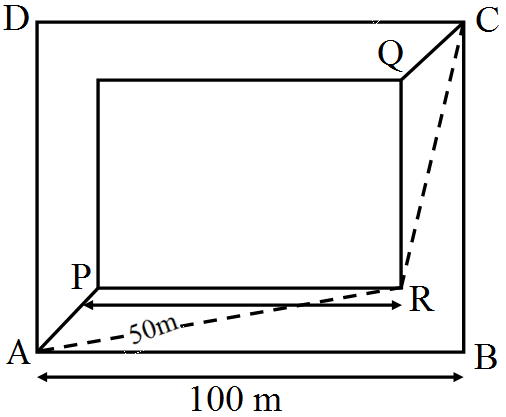
A man wants to reach from A to the opposite corner of the square C Fig. The sides of the square are 100m. A central square of 50m × 50m is filled with sand. Outside this square, he can walk at a speed 1m/ s. In the central square, he can walk only at a speed of $\upsilon\text{m/ s}(\upsilon<1)$. What is smallest value of v for which he can reach faster via a straight path through the sand than any path in the square outside the sand?
A trolley of mass $200kg$ moves with a uniform speed of $36km/h$ on a frictionless track. A child of mass $20kg$ runs on the trolley from one end to the other ($10m$ away) with a speed of $4ms^{-1}$ relative to the trolley in a direction opposite to the its motion, and jumps out of the trolley. What is the final speed of the trolley? How much has the trolley moved from the time the child begins to run?