MCQ
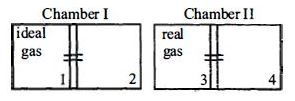
There are two identical chambers, completely thermally insulated from surroundings. Both chambers have a partition wall dividing the chambers in two compartments. Compartment $1$ is filled with an ideal gas and Compartment $3$ is filled with a real gas. Compartments $2$ and $4$ are vacuum . A small hole (orifice) is made in the partition walls and the gases are allowed to expand in vacuum

Statement $-1$ : No change in the temperature of the gas takes place when ideal gas expands in vacuum. However, the temperature of real gas goes down (cooling) when it expands in vacuum

Statement $-2$ : The internal energy of an ideal gas is only kinetic. The internal energy of a real gas is kinetic as well as potential
  • Statement $-1$ is false and Statement $-2$ is true
  • B
    Statement $-1$ and Statement $-2$ both are true. Statement $-2$ is the correct explanation of Statement $-1$ 
  • C
    Statement $-1$ is true and Statemcnt $-2$ is false
  • D
    Statement $-1$ and Statement $-2$ both are true. Statement $-2$ is not correct explanation of Statement $- 1$
Answer

Correct option: A.
Statement $-1$ is false and Statement $-2$ is true
a
In ideal gases the molecules are considered as point particles and for point particles, there is no internal excitation, no vibration and no rotation. For an ideal gas the internal energy can only be translational kinetic energy and for real gas both kinetic as well as potential energy

Need a full question paper?

Generate a complete, print-ready paper with questions like this in minutes — across 16+ boards, with answer keys.

Start Generating Free

Similar questions

A running man has half the kinetic energy of that of a boy of half of his mass. The man speeds up by $1\,m/s$ so as to have same K.E. as that of the boy. The original speed of the man will be
In terms of basic units of mass $(M)$, length $(L)$, time $(T)$ and charge $(Q)$, the dimensions of magnetic permeability of vacuum $\left(\mu_0\right)$ would be
A $0.5\, kg$ ball is thrown up with an initial speed $14\, m/s$ and reaches a maximum height of $8.0m. $ How much energy is dissipated by air drag acting on the ball during the ascent .......... $J$
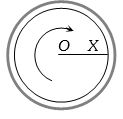
The diagram shows a cup of tea seen from above. The tea has been stirred and is now rotating without turbulence. A graph showing the speed $ v$ with which the liquid is crossing points at a distance $ X$  from $O $ along a radius $XO$  would look like
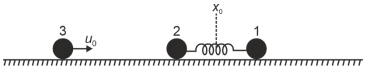
Two particles, $1$ and $2$ , each of mass $m$, are connected by a massless spring, and are on a horizontal frictionless plane, as shown in the figure. Initially, the two particles, with their center of mass at $x_0$, are oscillating with amplitude a and angular frequency $\omega$. Thus, their positions at time $t$ are given by $x_1(t)=\left(x_0+d\right)+a \sin \omega t$ and $x_2(t)=\left(x_0-d\right)-$ $a$ sin $\omega t$, respectively, where $d>2 a$. Particle $3$ of mass $m$ moves towards this system with speed $u_0=a \omega / 2$, and undergoes instantaneous elastic collision with particle 2 , at time $t_0$. Finally, particles $1$ and $2$ acquire a center of mass speed $v_{ cm }$ and oscillate with amplitude $b$ and the same angular frequency. . . . .

($1$) If the collision occurs at time $t_0=0$, the value of $v_{ cm } /(a \omega)$ will be

($2$) If the collision occurs at time $t_0=\pi /(2 \omega)$, then the value of $4 b^2 / a^2$ will be

Give the answer or quetion ($1$) and ($2$)

A body under the action of a force $\vec F = 6\hat i - 8\hat j\,N$ acquires an acceleration of $5\, ms^{-2}$. The mass of the body is 
A long spring is stretched by $2\ cm$ and its potential energy is $V.$ If the spring is stretched by $10\ cm,$ its potential energy will be:
The string of a violin emits a note of $205 \,Hz$ at its correct tension. The string is tightened slightly and then it produces six beats in two seconds with a tuning fork of frequency $205 Hz$. The frequency of the note emitted by the taut string is .......... $Hz$ 
Let $I_1$ and $I_2$ be the moments of inertia of two bodies of identical geometrical shape, the first made of aluminium and the second of iron.
A solid cylinder of mass $m$ is wrapped with an inextensible light string and, is placed on a rough inclined plane as shown in the figure. The frictional force acting between the cylinder and the inclined plane is:

[The coefficient of static friction, $\mu_{ s },$ is $\left.0.4\right]$