There is a current of $1.344\, amp$ in a copper wire whose area of cross-section normal to the length of the wire is $1\,m{m^2}$. If the number of free electrons per $c{m^3}$ is $8.4 \times {10^{22}}$, then the drift velocity would be
Easy


Download our appand get started for free
Experience the future of education. Simply download our apps or reach out to us for more information. Let's shape the future of learning together!No signup needed.*
Similar Questions
- 1If two wires having resistance $R$ and $2R$. Both joined in series and in parallel then ratio of heat generated in this situation, applying the same voltage,View Solution
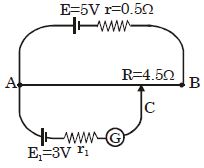
- 2In the given potentiometer circuit length of the wire $AB$ is $3\,m$ and resistance is $R = 4.5 \,\Omega.$ The length $AC$ for no deflection in galvanometer is ................ $\mathrm{m}$View Solution
- 3Resistance of rod is calculated by measuring its length with help of meter scale of least count $1\ mm$ . Its radius is measured with help of screw gauge having $50$ division on circular scale and pitch is of $1\ mm$ . Resistivity of material is exact. Length of the wire is found to be $20\ cm$ and diameter of wire is $4\ mm$ . Find the percentage error in calculation of resistance ............... $\%$View Solution
- 4In the circuit element given here, if the potential at point $B$, $V_B = 0$, then the potentials of $A$ and $D$ are given asView Solution

- 5A cell of emf $6\, V$ and resistance $0.5\, ohm$ is short circuited. The current in the cell is ............... $amp$View Solution
- 6The internal resistance of a $2.1\, V$ cell which gives a current of $0.2\, A$ through a resistance of $10\,\Omega$ is ............. $\Omega$View Solution
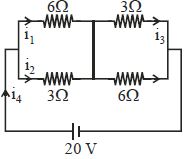
- 7View SolutionDiagram shows a circuit diagram choose incorrect statement
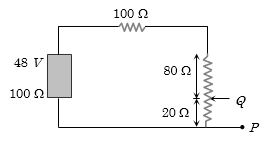
- 8In the circuit, the potential difference across $PQ$ will be nearest to .............. $V$View Solution
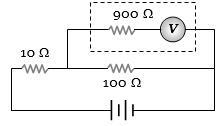
- 9The potential difference across the $100\,\Omega$ resistance in the following circuit is measured by a voltmeter of $900 \,\Omega$ resistance. The percentage error made in reading the potential difference isView Solution
- 10The current in the primary circuit of a potentiometer is $0.2\, A$. The specific resistance and cross section of the potentiometer wire are $4\times10^{-7}\,ohm$ $metre$ and $8\times10^{-7}\, m^2$ respectively. The potential gradient will be equal to .............. $V/m$View Solution