MCQ
There is no hole current in conductors, because they have:
- AHigh conductivity
- BHigh electron density
- CNo valence band
- DOverlapping of valence and conduction bands.
Explanation:
In conductors, electrons are loosely bound to the nucleus hence, can detach easily at room temperature. Also, a large number of free electrons thus, available are conduction electrons. When the covalent bond breaks, electrons are freed from the atom.
The departure of an electron from valence band creates the vacancy in bond, this vacancy is known as hole. This hole is captured by another free electron.
Also, the energy level of free electrons corresponds to the conduction level, hence valance level and conduction level are overlapped. So there are no holes in conduction level to carry hole current.
Generate a complete, print-ready paper with questions like this in minutes — across 16+ boards, with answer keys.
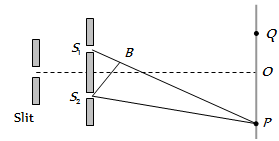
In the figure is shown Young’s double slit experiment. Q is the position of the first bright fringe on the right side of O. P is the 11th fringe on the other side, as measured from Q. If the wavelength of the light used is 6000  , then
  will be equal to
|
(a) 6 |
(b) 6.6 |
(c) 3.138 |
(d) 3.144 |
If a slab of insulating material 4  thick is introduced between the plates of a parallel plate capacitor, the separation between plates has to be increased by 3.5 to restore the capacity to original value. The dielectric constant of the material will be
|
(a) 6 |
(b) 8 |
(c) 10 |
(d) 12 |
The field of view is maximum for
|
(a) Plane mirror |
(b) Concave mirror |
(c) Convex mirror |
(d) Cylindrical mirror |
Assertion : Electron capture occurs more often than positron emission in heavy elements.
Reason : Heavy elements exhibit radioactivity.
|
(a) If both assertion and reason are true and the reason is the correct explanation of the assertion. |
|
(b) If both assertion and reason are true but reason is not the correct explanation of the assertion. |
|
(c) If assertion is true but reason is false. |
|
(d) If the assertion and reason both are false. |
 mesons can be
|
(a) |
(b) |
(c) |
(d) |
A light source approaches the observer with velocity 0.8 c. The doppler shift for the light of wavelength 5500 Å is
|
(a) 4400 Å |
(b) 1833 Å |
(c) 3167 Å |
(d) 7333 Å |
Light enters at an angle of incidence in a transparent rod of refractive index n. For what value of the refractive index of the material of the rod the light once entered into it will not leave it through its lateral face whatsoever be the value of angle of incidence
|
(a) n > |
(b) n = 1 |
(c) n = 1.1 |
(d) n = 1.3 |
The thermocouple is based on the principle of
|
(a) Seebeck effect |
(b) Thomson effect |
(c) Peltier effect |
(d) Joule effect |


