Question
There is only one possible sequence of amino acids when deduced from a given nucleotide. But multiple nucleotide sequences can be deduced from a single amino acid sequence. Explain this phenomenon.

Answer

Some amino acids are coded by more than one codon (known as degeneracy of codon), hence on deducing a nucleotide sequence from an amino acid sequence, multiple nucleotide sequences will be obtained.
For example: isoleucine has three codons AUU, AUC and AUA. Hence a dipeptide Met-Ile can have any of the following nucleotide sequences:
  1. AUG - AUU
  2. AUG - AUC
  3. AUG - AUA
If we deduce amino acid sequences of the above nucleotide sequences, all the three will code for Met-Ile.

Need a full question paper?

Generate a complete, print-ready paper with questions like this in minutes — across 16+ boards, with answer keys.
Start Generating Free

Similar questions

You have a friend whose parents are too indulgent in his/her daily affairs. They think him/her to be still young which makes him/her sad and is upset all the time. As he/she feels that the parents should give him/her opportunity to take independent decision on some issues.
  1. Would you support your friend and why?
  2. Write the characteristics of this age group.
  3. List two curative measures.
Taking a small pond as an example of an ecosystem, list the four components of this ecosystem. How do these components function as a unit in a small pond?
Answer the following questions:
Explain the role of ovarian hormones in inducing changes in the uterus during menstrual cycle.
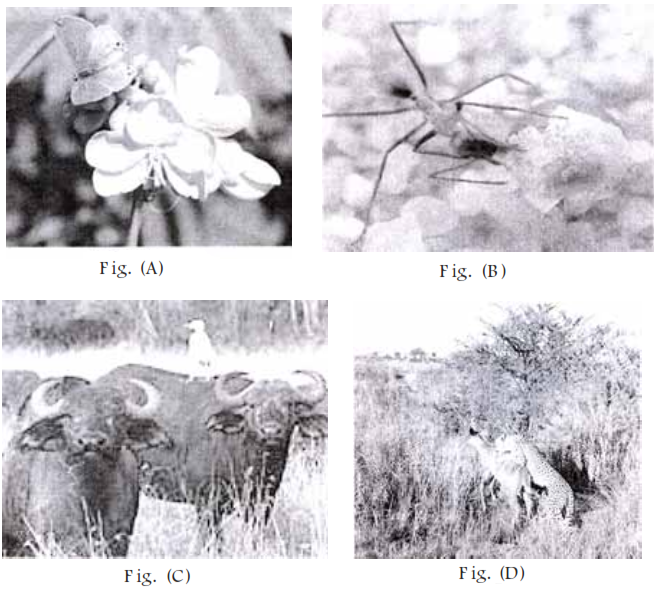
Observe the set of 4 figures A, B, C and D and, answer the following questions,
  1. Which one of the figures shows mutualism?
  2. What kind of association is shown in D?
  3. Name the organisms and the association in C.
  4. What role is the insect performing in B?
​​​​​​​
For question 1-4, use this key:

Key-

  1. Ecology.
  2. Population.
  3. Community.
  4. Ecosystem.
  1. A community plus its physical environment.
  2. Study of the interactions of organisms with each other and with the physical environment.
  3. All populations that are found in a particular area.
  4. All members of the same species that inhabit a particular area.
(i) Explain the significance of each of the following features present in plants given below:, (a) In rose-bay plant the stamens ripen before the stigma., (b) In certain species of primrose, the flowers have short stamen and long style., (c) The bisexual flower of mustard exhibits rejection of self-pollen grain., (ii) Explain how autogamy is prevented in castor and papaya plant respectively.
Arrange the following in the decreasing order (most important first) of their importance, for the welfare of human society. Give reasons for your answer.
Study the table given below and answer the questions that follow:
Species A
Species B
Name of interaction
(+)
(+)
(A)
(-)
(-)
(b)
(+)
(-)
(c)
(+)
(0)
(d)
+ = Beneficial interaction
- = Detrimental interaction
0 = Neutral interaction
Identify a, b, c and d in the given table and explain any three of them with the help of an example each.
List any two major causes other than anthropogenic causes of the loss of biodiversity.
If a desired gene is identified in an organism for some experiments, explain the process of the following:
i. Cutting this desired gene at specific location.
ii. Synthesis of multiple copies of this desired gene.