Question
There is only one possible sequence of amino acids when deduced from a given nucleotide. But multiple nucleotide sequences can be deduced from a single amino acid sequence. Explain this phenomenon.

Answer

Some amino acids are coded by more than one codon (known as degeneracy of codon), hence on deducing a nucleotide sequence from an amino acid sequence, multiple nucleotide sequences will be obtained.
For example: isoleucine has three codons AUU, AUC and AUA. Hence a dipeptide Met-Ile can have any of the following nucleotide sequences:
  1. AUG - AUU
  2. AUG - AUC
  3. AUG - AUA
If we deduce amino acid sequences of the above nucleotide sequences, all the three will code for Met-Ile.

Need a full question paper?

Generate a complete, print-ready paper with questions like this in minutes — across 16+ boards, with answer keys.
Start Generating Free

Similar questions

What are fossils? How many types of fossils are there? How will you determine the age of fossils?
Answer the following questions:
Explain Mendel’s law of independent assortment by taking a suitable example.
Answer the following questions:
Describe the stages in embryo development in a dicot plant.
Answer the following questions:
Explain how recombinants and non-recombinants are differentiated on the basis of colour production in the presence of a chromogenic substrate. Name that procedure.
  1. Why should we conserve biodiversity? How can we do it?
  2. Explain the importance of biodiversity hot-spots and sacred groves.
What is spermatogenesis? Explain the process briefly.
How are Mendelian inheritance, polygenic inheritance and pleiotropy different from each other?
A gene was identified in a fungus by a research worker in a lab which was considered to be of a great importance in the field of agriculture. As a student of biotechnology, write the steps you would suggest to (i) Isolate this gene of interest from the fungus and (ii) amplify this gene for further experimentation and research.
Describe the functions of the following:
Epididymis.
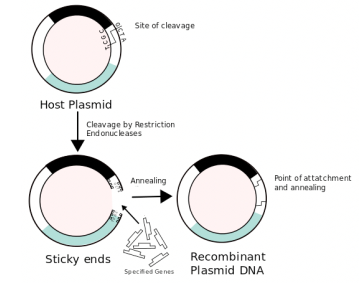
Recombinant DNA vectors are typically attenuated viruses or bacteria that are unrelated to the pathogen of interest.
These vectors can penetrate human cells and often replicate within them, but do not cause disease in the host.

Image
i. A recombinant vector with a gene of interest inserted within the gene of a-galactosidase enzyme, is introduced into a bacterium. Explain the method that would help in selection of recombinant colonies from non-recombinant ones.
ii. Why is this method of selection referred to as insertional inactivation?