Question
Things to keep in mind to get the image formed by the lens.

Answer

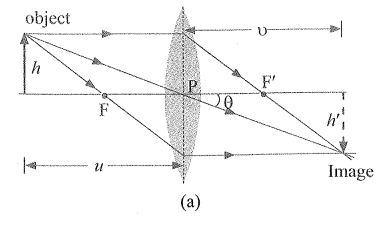
→To find the image of an object by a lens, we can, in principal, take any two rays emanating from a point on an object, trace their paths using the laws of refraction and find the point where the refracted rays meet (or appear to meet). In practice, however, it is convenient to choose any two of the following rays:
Image
Image
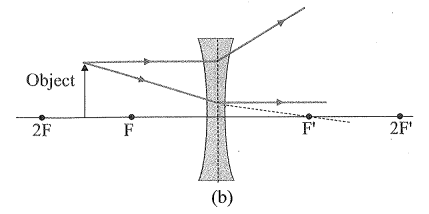
(i) A ray emanating from the object parallel to the principle axis of the lens after refraction passes through the second principal focus (in a convex lens) or appears to diverge (in a concave lens) from the first principal focus.
(ii) A ray of light, passing through the optical centre of the lens, emerges without any deviation after refraction.
(iii) A ray of light passing through the first principal focus of a convex lens (or appearing to meet principal axis at second focus point of a concave lens) emerges parallel to the principal axis after refraction.
→Figure (a) and (b) illustrate these rules for a convex and a concave lens.
Need a full question paper?

Generate a complete, print-ready paper with questions like this in minutes — across 16+ boards, with answer keys.

Start Generating Free

Similar questions

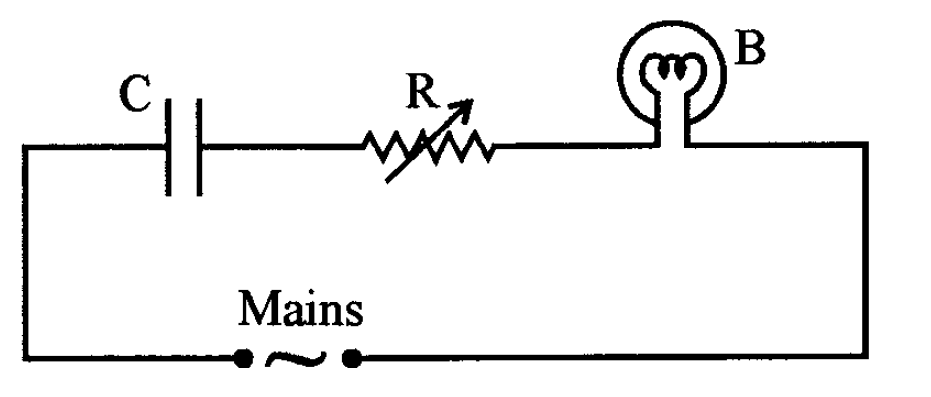
A capacitor'C', a variable resistor 'R' and a bulb oB' are connected in series to the ac mains in circuit as shown. The bulb glows with some brightness. How will the glow of the bulb change if (i) a dielectric slab is introduced between the plates of the capacitor, keeping resistance R to be the same; (ii) the resistance R is increased keeping the same capacitance?
A capacitor, made of two parallel plates each of plate area A and separation d, is being charged by an external ac source. Show that the displacement current inside the capacitor is the same as the current charging the capacitor.
The yellow colour has a greater luminous efficiency as compared to the other colours. Can we increase the illuminating power of a white light source by putting a yellow plastic paper around this source?
Write the difference between polar and non-polar dieelctric.
The electric current existing in a discharge tube is $2.0\mu\text{A}.$ How much charge is transferred across a cross-section of the tube in 5 minutes?
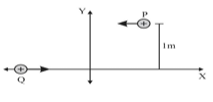
$P$ and $Q$ are two identical charged particles each of mass $4 \times 10^{-26} kg$ and charge $4.8 \times 10^{-19} C$, each moving with the same speed of $2.4 \times 10^5 m / s$ as shown in the figure. The two particles are equidistant $(0.5 m)$ from the vertical $Y -$axis. At some instant, a magnetic field $B$ is switched on so that the two particles undergo head$-$on collision.

Image
Find $–$
$(I)$ the direction of the magnetic field and
$(II)$ the magnitude of the magnetic field applied in the region.
White light is used in a Young's double slit experiment. Find the minimum order of the violet fringe $(\lambda=400\text{nm}),$ which overlaps with a red fringe $(\lambda=700\text{nm}).$
Write a brief history of Electro Magnetic waves.
Compare the direction of the magnetic field inside a solenoid with that of the field there if the solenoid is replaced by its equivalent combination of north pole and south pole.
If a compressed spring is dissolved in acid, what happened to the elastic potential energy of the spring?