Question
Things to keep in mind to get the image formed by the lens.

Answer

→To find the image of an object by a lens, we can, in principal, take any two rays emanating from a point on an object, trace their paths using the laws of refraction and find the point where the refracted rays meet (or appear to meet). In practice, however, it is convenient to choose any two of the following rays:
Image
Image
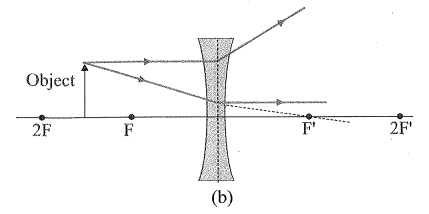
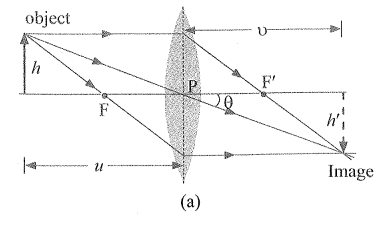
(i) A ray emanating from the object parallel to the principle axis of the lens after refraction passes through the second principal focus (in a convex lens) or appears to diverge (in a concave lens) from the first principal focus.
(ii) A ray of light, passing through the optical centre of the lens, emerges without any deviation after refraction.
(iii) A ray of light passing through the first principal focus of a convex lens (or appearing to meet principal axis at second focus point of a concave lens) emerges parallel to the principal axis after refraction.
→Figure (a) and (b) illustrate these rules for a convex and a concave lens.

Need a full question paper?

Generate a complete, print-ready paper with questions like this in minutes — across 16+ boards, with answer keys.

Start Generating Free

Similar questions

A point source is placed at a depth h below the surface of water (refractive index = μ).
  1. Show that light escapes through a circular area on the water surface with its centre directly above the point source.
  2. Find the angle subtended by a radius of the area on the source.
Draw a graph between photoelectric current and anode potential for two light beams of different intensity and same wavelength.
Explain how the mass of an electron can be found using Millikan's oil drop experiment.
Can a gravitational field be added vectorially to an electric field to get a total field?
A point source is placed at a depth h below the surface of water (refractive index = μ).
  1. Show that light escapes through a circular area on the water surface with its centre directly above the point source.
  2. Find the angle subtended by a radius of the area on the source.
An electric current of 2.0A passes through a wire of resistance $25\Omega$. How much heat will be developed in 1minute?
The photoelectric cut-off voltage in a certain experiment is 1.5 V. What is the maximum kinetic energy of photoelectrons emitted?
Two heating coils, one of fine wire and other of thick wire, made of the same material and of the same length are connected one by one to a source of electricity. Which coil will produce heat at a greater rate?
Draw the series L-C-R AC circuit and obtain the relationship between voltage and current for this circuit. (Derive the necessary equations.)
An inductor is connected to a battery through a switch. Explain why the emf induced in the inductor is much larger when the switch is opened as compared to the emf induced when the switch is closed.