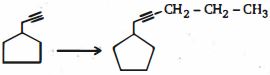
- A$NaNH_2, CH_3CHO$
- ✓$NaNH_2, CH_3-CH_2-CH_2-Br$
- C$KOH, CH_3 - CH_2 - Br$
- D$KOH,$ $\begin{array}{*{20}{c}}
{C{H_2} - C{H_2}} \\
{|\,\,\,\,\,\,\,\,\,\,\,\,\,\,|\,\,\,\,\,\,} \\
{\,\,Br\,\,\,\,\,\,\,Br\,\,\,\,\,\,\,}
\end{array}$

Generate a complete, print-ready paper with questions like this in minutes — across 16+ boards, with answer keys.
| $Cl_2(g) \rightarrow 2Cl(g),$ | $242.3\,kJ\,mol^{-1}$ |
| $I_2(g) \rightarrow 2I(g),$ | $151.0\,kJ\,mol^{-1}$ |
| $ICl(g) \rightarrow I(g)+Cl(g),$ | $211.3\,kJ\,mol^{-1}$ |
| $I_2(s) \rightarrow I_2(g),$ | $62.76\,kJ\,mol^{-1}$ |
Given that the standard states for iodine and chlorine are $I_2(s)$ and $Cl_2(g),$ the standard enthalpy of formation for $ICl(g)$ is : ............... $\mathrm{kJ\,mol}^{-1}$

$S_2O_8^{2-} + 2e^- \longrightarrow 2SO_4^{2-}$
$Mn^{2+} + 4H_2O \longrightarrow MnO_4 + 8H^+ + 5e^-$
How many moles of $S_2O_8^{2-}$ are required to oxidise $1\, mole$ of $Mn^{ 2+}$ ?
$A$. Hydrogen bonding exists when $\mathrm{H}$ is covalently bonded to the highly electro negative atom.
$B$. Intermolecular $\mathrm{H}$ bonding is present in o-nitro phenol
$C$. Intramolecular $\mathrm{H}$ bonding is present in $\mathrm{HF}$.
$D$. The magnitude of $\mathrm{H}$ bonding depends on the physical state of the compound.
$E$. H-bonding has powerful effect on the structure and properties of compounds.
Choose the correct answer from the options given below :