Question
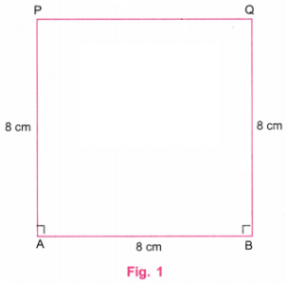
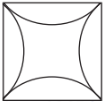
This is a square with 8 cm sidelengths.
Image
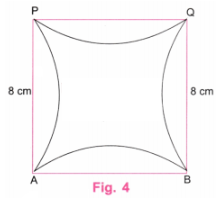
Construct a “Square with Curves ”, taking a square of side 8 cm as shown in the figure.
Hint: Think where the tip of the compass can be placed to get all 4 arcs to bulge uniformly from each of the sides. Try it out!

Answer

In the given figure, the centres of the four arcs are outside the square.
Step 1. Using a ruler, draw a line AB equal to 8 cm. Using a protractor, draw perpendicular lines at A and B. Using a ruler, mark point P on the perpendicular line at A such that AP = 8 cm. Using a ruler, mark point Q on the perpendicular line at B such that BQ = 8 cm. Join P and Q using a ruler. Erase the lines above P and Q. (Fig. 1)
Image
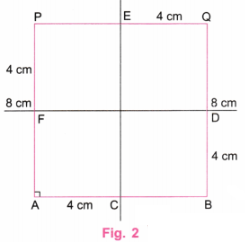
Step 2. Using a ruler, mark points C, D, E, and F such that AC = 4 cm, BD = 4 cm, QE = 4 cm, and PF = 4 cm. Join C and E and also D and F. Extend these lines outside the square. (Fig. 2)
Image
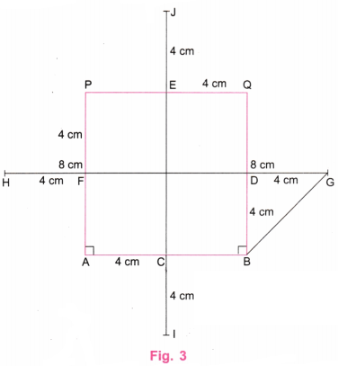
Step 3. Extend DF and take points G and H on it so that DG and FH are equal to 4 cm. Extend CE and take points I and J on it so that Cl and EJ are equal to 4 cm. The distance 4 cm can be taken slightly less than or greater than 4 cm. Join B and G. (Fig. 3)
Image
Step 4. With centres at G, H, I, and J and a radius equal to BG, draw four arcs inside the square as shown in the given figure. Erase the extra lines. (Fig. 4).
Image
Step 5. Fig. 4 is the required “Square with Curves” with the square of side 8 cm.
Need a full question paper?

Generate a complete, print-ready paper with questions like this in minutes — across 16+ boards, with answer keys.

Start Generating Free

Similar questions

Complete the following table:
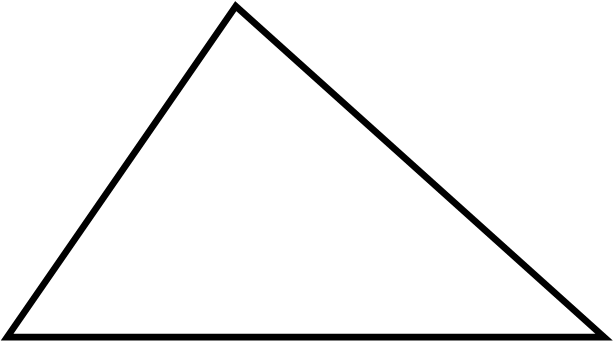
No. Shapes Rough figure Number of lines of symmetry
$(i)$ Scalene triangle $0$
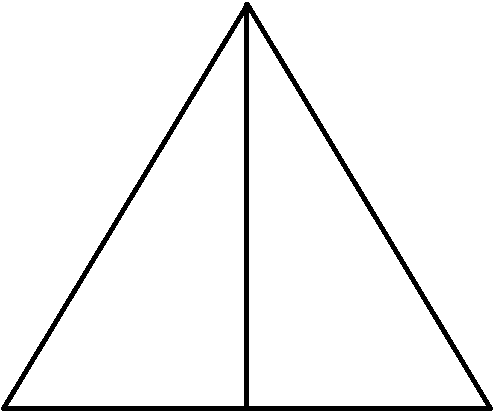
$(ii)$ Isosceles triangle $1$
$(iii)$ Equilateral triangle    
$(iv)$ Rectangle    
$(v)$ Square    
$(vi)$ Parallelogram    
$(vii)$ Rhombus    
$(viii)$ Line    
$(ix)$ Line segment    
$(x)$ Angle    
$(xi)$ Isosceles trapezium    
$(xii)$ Kite    
$(xiii)$ Arrow head    
$(xiv)$ Semi-circle    
$(xv)$ Circle    
$(xvi)$ Regular pentagon    
$(xvii)$ Regular pentagon    
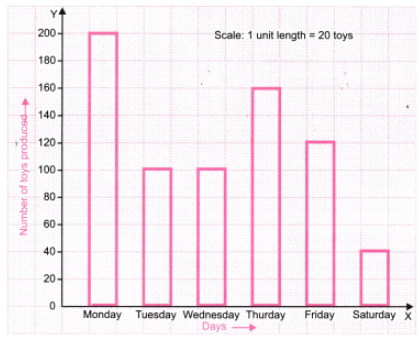
Refer to question $39.$ Prepare a pictograph of the data by taking a suitable symbol to represent $200$ kilometers.
Draw an angle and label it as $\angle\text{BAC}.$ Draw its bisector ray $AX$ and take a point $P$ on it. From $P$ draw line segments $PM$ and $PN,$ such that $\text{PM}\perp\text{AB}$ and $\text{PN}\perp\text{AC},$ where $M$ and $N$ are respectively points on rays $AB$ and $AC$. Measure $PM$ and $PN.$ Are the two lengths equal$?$
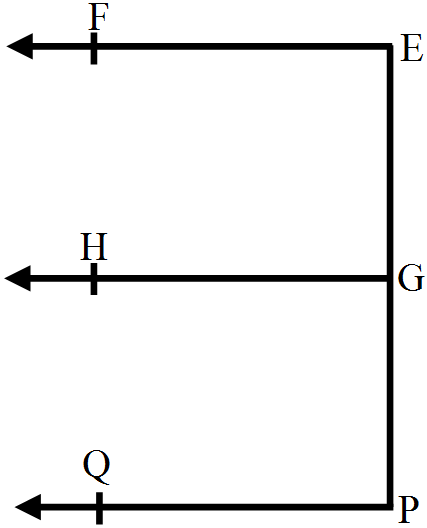
Identify and name the line segments and rays in the following figure:
Draw an angle of $70^\circ .$ Make a copy of it using only a straight edge and compasses.
Write the fraction representing the shaded portion
Solve the following equation and verify the answer: $3(x + 6) + 2(x + 3) = 64$
The angles of a triangle are in the ratio $1 : 2 : 3.$ The measure of the largest angle is: