MCQ
this reaction known as
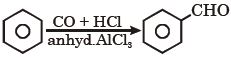
- AGatterman aldehyde synthesis
- ✓Gatterman-koch aldehyde synthesis
- CWilliamson's synthesis
- DReed's reaction
Generate a complete, print-ready paper with questions like this in minutes — across 16+ boards, with answer keys.
| Column - $I$ | Column - $II$ |
| $(a)$ Copper | $(i)$ Non-metal |
| $(b)$ Fluorine | $(ii)$ Transition Metal |
| $(c)$ Silicon | $(iii)$ Lanthanoid |
| $(d)$ Cerium | $(iv)$ Metalloid |
Identify the correct match:
| Exp. | $[A]$ | $[B_2]$ | Rate $(mol\,L^{-1}\,S^{-1})$ |
| $1$ | $0.50$ | $0.50$ | $1.6 \times {10^{ - 4}}$ |
| $2$ | $0.50$ | $1.00$ | $3.2 \times {10^{ - 4}}$ |
| $3$ | $1.00$ | $1.00$ | $3.2 \times {10^{ - 4}}$ |
The rate law
Statement $I:$ The boiling points of aldehydes and ketones are higher than hydrocarbons of comparable molecular masses because of weak molecular association in aldehydes and ketones due to dipole - dipole interactions.
Statement $II:$ The boiling points of aldehydes and ketones are lower than the alcohols of similar molecular masses due to the absence of $H$-bonding.
In the light of the above statements, choose the most appropriate answer from the options given below :