Thomson coefficient of a conductor is $10\,\mu V/K$. The two ends of it are kept at ${50\,^o}C$ and ${60\,^o}C$ respectively. Amount of heat absorbed by the conductor when a charge of $10\,C$ flows through it is
Easy


Download our appand get started for free
Experience the future of education. Simply download our apps or reach out to us for more information. Let's shape the future of learning together!No signup needed.*
Similar Questions
- 1A $25\, watt$, $220\, volt$ bulb and a $100\, watt$, $220\, volt$ bulb are connected in parallel across a $220\, volt$ line. Which bulb will glow more brightlyView Solution
- 2A $10\, ohm$ electric heater operates on a $110\, V$ line. Calculate the rate at which it develops heat in ............... $watts$View Solution
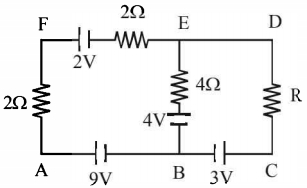
- 3In the electric network shown, when no current flows through the $4 \Omega$ resistor in the arm EB, the potential difference between the points $A$ and $D$ will be $.............\,V$View Solution
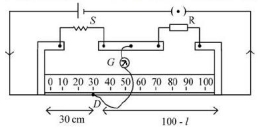
- 4In meter bridge experiment for measuring unknown resistance ' $S$ ', the null point is obtained at a distance $30 cm$ from the left side as shown at point $D$. If $R$ is $5.6 k \Omega$, then the value of unknown resistance ' $S$ ' will be $\Omega .$View Solution
- 5The temperature dependence of resistances of $Cu$ and undoped $Si$ in the temperature range $300-400\ K$, is best described byView Solution
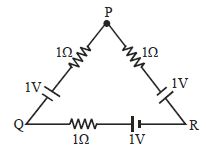
- 6In given circuit find potential difference between $P$ and $Q$ .................. $V$View Solution
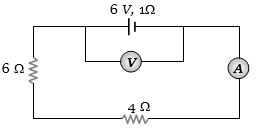
- 7View SolutionIn the circuit shown here, the readings of the ammeter and voltmeter are
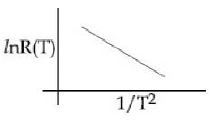
- 8View SolutionIn an experiment, the resistance of a material is plotted as a function of temperature (in some range). As shown in the figure, it is a straight line. One may conclude that:
- 9A uniform heating wire of resistance $36\, \Omega$ is connected across a potential difference of $240\, {V}$ The wire is then cut into half and potential difference of $240\, {V}$ is applied across each half separately. The ratio of power dissipation in first case to the total power dissipation in the second case would be $1: {x}$, where ${x}$ is........... .View Solution
- 10Two electric bulbs whose resistances are in the ratio of $1 : 2$ are connected in series. The powers dissipated in them have the ratioView Solution