MCQ
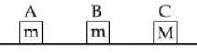
Three blocks $A, B$ and $C$ are lying on a smooth horizontal surface, as shown in the figure. $A$ and $B$ have equal masses, $m$ while $C$ has mass $M$. Block $A$ is given an initial speed $v$ towards $B$ due to which it collides with $B$ perfectly inelastically. The combined mass collides with $C$, also perfectly inelastically. The combined mass collides with $C$, also perfectly inelastically if $\frac{5}{6}^{th}$ of the initial kinetic energy is lost in whole process. What is value of $M/m$ ?
  • A
    $5$
  • B
    $2$
  • $4$
  • D
    $3$

Answer

Correct option: C.
$4$
c
Apply $LMC$ (Linear Momentum Conservation)

$mv = (2m + M) v'$

$v' = \frac{{mv}}{{2m + M}}$

Initial energy 

$\frac{1}{2}$ $m{v^2}$

Final energy 

$\frac{1}{2}\,\left( {2m + M} \right){\left( {\frac{{mv}}{{2m + M}}} \right)^2}$

$Initial\, kinetic\, energy - Final\, Kinetic\, energy =$  $\frac{5}{6}$ of initial kinetic energy.

After solving, we get, $\frac{M}{m} = 4.$

Need a full question paper?

Generate a complete, print-ready paper with questions like this in minutes — across 16+ boards, with answer keys.

Start Generating Free

Similar questions

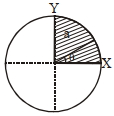
The disc of mass $M$ with uniform surface mass density $\sigma$ is shown in the figure. The centre of mass of the quarter disc (the shaded area) is at the position $\frac{x}{3} \frac{a}{\pi}, \frac{x}{3} \frac{a}{\pi}$ where $x$ is ....... .

(Round off to the Nearest Integer) $[ a$ is an area as shown in the figure $]$

The reason for the force exerted by a gas on the wall of the vessel is that the molecules of the gas:
The $x$ and $y$ coordinates of a particle at any time $t$ are given by $x = 7t + 4{t^2}$ and $y = 5t$, where $x$ and $y$ are in metre and $t$ in seconds. The acceleration of particle at $t = 5\;s$ is.........$m/{s^2}$
The length of a simple pendulum is increased by $44\%$. What is the percentage increase in its time period?
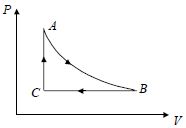
A fixed amount of a gas undergoes a thermodynamic process as shown such that heat interaction along path $B \to C \to A$ is equal to the work done by the gas along path $A \to B \to C$. Then process $A \to B$ is :-
A particle is acted upon by a force of constant magnitude which is always perpendicular to the velocity of the particle. The motion of the particle takes place in a plane. It follows that:
  1. Its velocity is constant.
  2. Its acceleration is constant.
  3. Its kinetic energy is constant.
  4. It moves in a circular path.
$1kWh = $
Two cars $A$ and $B$ are travelling in the same direction with velocities ${v_1}$ and ${v_2}$$({v_1} > {v_2})$. When the car $A$ is at a distance $d$ ahead of the car $B$, the driver of the car $A$ applied the brake producing a uniform retardation $a$ There will be no collision when
Acceleration of a body is given by $\frac{\text{dv}}{\text{dt}}=4-2\text{v}.$ The body started from rest $t = 0.$ Then:
Moment of inertia $(M.I.)$ of four bodies, having same mass and radius, are reported as;

$I _{1}= M$. of thin circular ring about its diameter.

$I _{2}=$ $M.I.$ of circular disc about an axis perpendicular to the disc and going through the centre,

$I _{3}=$ $M.I.$ of solid cylinder about its axis and

$I _{4}= M . I.$ of solid sphere about its diameter. Then