Question
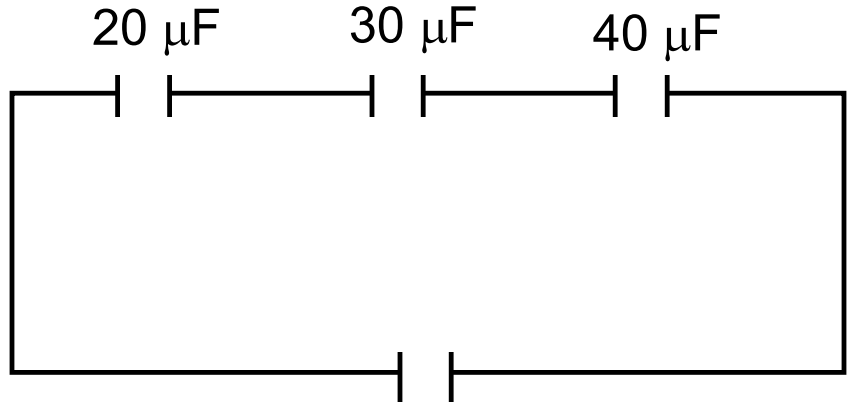
Three capacitors having capacitances $20\mu\text{F},\ 30\mu\text{F}$ and $40\mu\text{F}$ are connected in series with a 12V battery. Find the charge on each of the capacitors. How much work has been done by the battery in charging the capacitors?

Answer


$\therefore$ The equivalent capacity
$\text{C}=\frac{\text{C}_1\text{C}_2\text{C}_3}{\text{C}_2\text{C}_3+\text{C}_1\text{C}_3+\text{C}_1\text{C}_2}$
$=\frac{20\times30\times40}{30\times40+20\times40+20\times30}=\frac{24000}{2600}=9.23\mu\text{F}$
Let Equivalent charge at the capacitor = q
$\text{C}=\frac{\text{q}}{\text{V}}$
$\Rightarrow\text{q}=\text{C}\times\text{V}=9.23\times12=110\mu\text{C}$ on each.
As this is a series combination, the charge on each capacitor is same as the equivalent charge which is $110\mu\text{C}.$
Let the work done by the battery = W
$\therefore\text{V}=\frac{\text{W}}{\text{q}}$
$\Rightarrow\text{W}=\text{Vq}=110\times12\times10^{-6}$
$=1.33\times10^{-3}\text{J.}$

Need a full question paper?

Generate a complete, print-ready paper with questions like this in minutes — across 16+ boards, with answer keys.

Start Generating Free

Similar questions

What is Gauss theorem? With its help, obtain an expression for the electric field intensity at any point near a uniformly charged linear conductor of infinite length.###Make the necessary diagram and with the help of Gauss law, calculate the electric field intensity at any point due to a charged wire of infinite length. Plot the change in intensity with distance.###Define Gauss' law. With its help, find the value of electric field intensity at a distance from a uniformly charged linear conductor of infinite extension. Make the necessary diagram and also make a graph of the change of electric field with distance.
A metre scale made of steel reads accurately at $20^{\circ} \mathrm{C}$. In a sensitive experiment, distances accurate up to 0.055 mm in 1 m are required. Find the range of temperature in which the experiment can be performed with this metre scale. Coefficient of linear expansion of steel $=11 \times 10^{-6}{ }^{\circ} \mathrm{C}^{-1}$.
A concave mirror forms an image of 20cm high object on a screen placed 5.0m away from the mirror. The height of the image is 50cm. Find the focal length of the mirror and the distance between the mirror and the object.
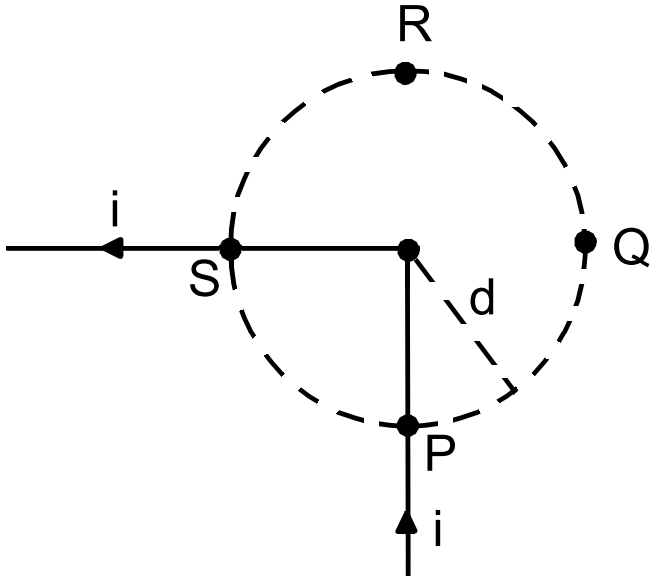
Figure shows a long wire bent at the middle to form a right angle. Show that the magnitudes of the magnetic fields at the points P, Q, R and S are equal and find this magnitude.
Shiv had a high tension tower erected on his farm land. He kept complaining to the authorities to remove it since it occupied a large portion of his land. His uncle, who was a teacher, explained to him the need for erecting these towers for efficient transmission of power. As Shiv got convinced and realised significance, he stopped complaining.
Based on the above paragraph, answer the following questions:
  1. Why is it necessary to transport power at high voltages?
  2. ‘A low power factor implies large power loss'. Explain.
  3. Write the two values displayed by Shiv and his Uncle.
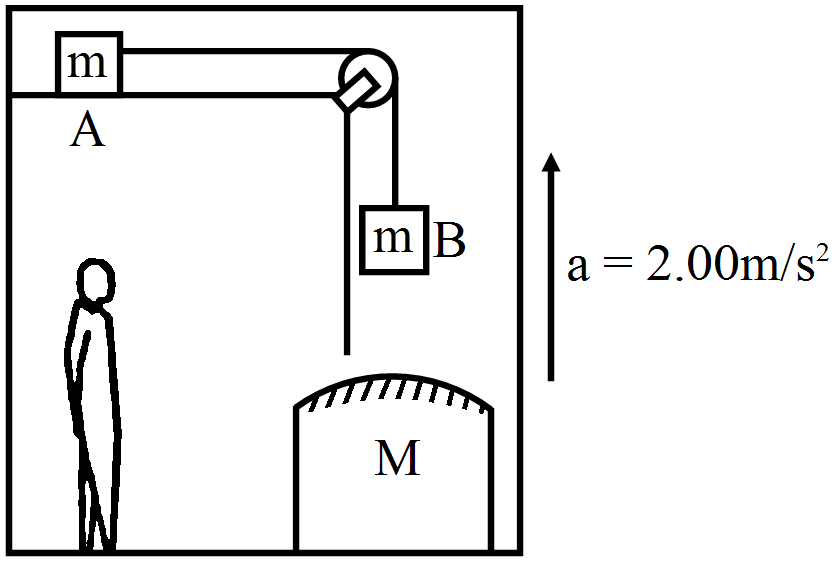
Consider the situation shown in figure. The elevator is going up with an acceleration of $2.00m/s^2$ and the focal length of the mirror is 12.0cm. All the surfaces are smooth and the pulley is light. The mass-pulley system is released from rest (with respect to the elevator) at t = 0 when the distance of B from the mirror is 42.0cm. Find the distance between the image of the block B and the mirror at $t = 0.200s$. Take $g = 10m/s^2$.
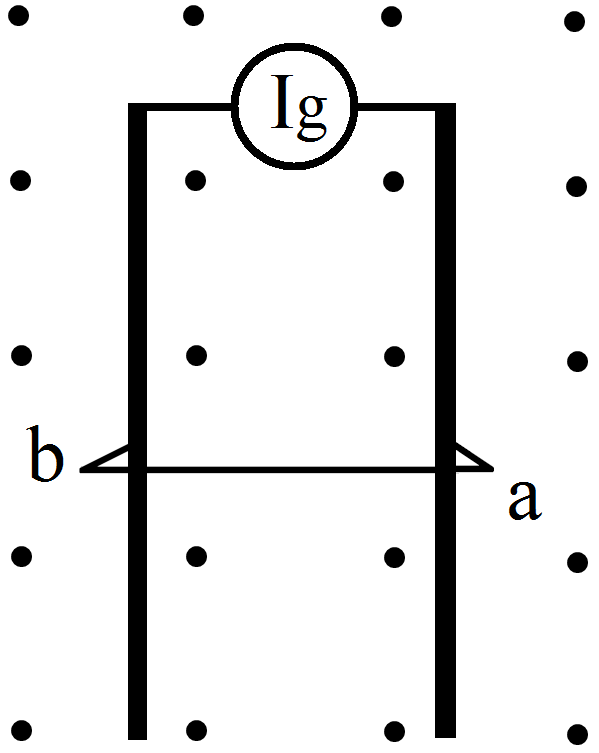
The system containing the rails and the wire of the previous problem is kept vertically in a uniform horizontal magnetic field B that is perpendicular to the plane of the rails (figure). It is found that the wire stays in equilibrium. If the wire ab is replaced by another wire of double its mass, how long will it take in falling through a distance equal to its length?
An object is placed at a distance of 30cm from a converging lens of focal length 15cm. A normal eye (near point 25cm, far point infinity) is placed close to the lens on the other side.
  1. Can the eye see the object clearly?
  2. What should be the minimum separation between the lens and the eye so that the eye can clearly see the object?
  3. Can a diverging lens, placed in contact with the converging lens, help in seeing the object clearly when the eye is close to the lens?
In an experiment to measure the speed of light by Fizeau's apparatus, following data are used:
Distance between the mirrors = 12.0km,
Number of teeth in the wheel = 180.
Find the minimum angular speed of the wheel for which the image is not seen.
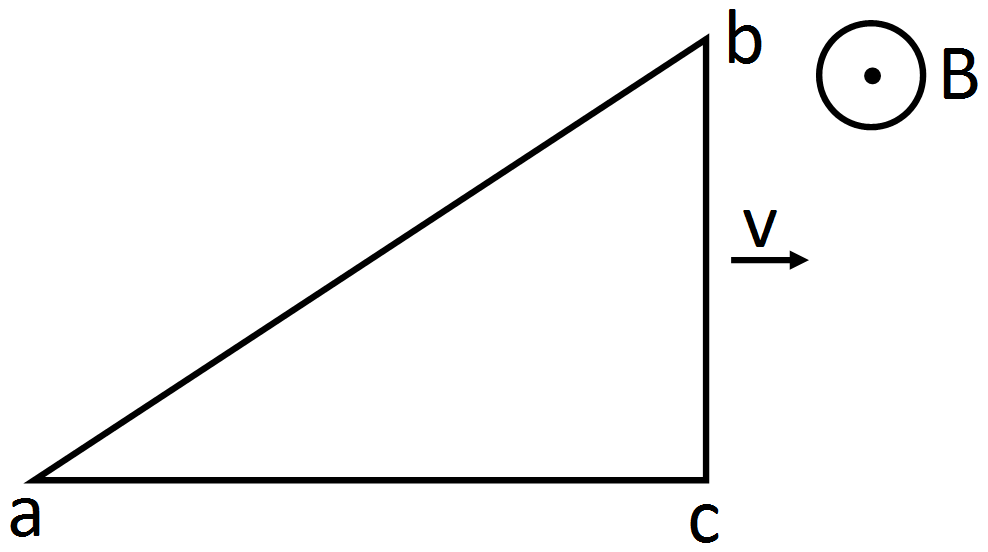
A right-angled triangle abc, made from a metallic wire, moves at a uniform speed v in its plane as shown in figure. A uniform magnetic field B exists in the perpendicular direction. Find the emf induced:
  1. In the loop abc.
  2. In the segment bc.
  3. In the segment ac.
  4. In the segment ab.