MCQ
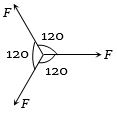
Three concurrent forces of the same magnitude are in equilibrium. What is the angle between the forces  Also name the triangle formed by the forces as sides
  • $120^°$ equilateral triangle
  • B
    $60^°$ equilateral triangle
  • C
    $120^°, 30^°, 30^° $ an isosceles triangle
  • D
    $120^°$ an obtuse angled triangle

Answer

Correct option: A.
$120^°$ equilateral triangle
a
(a) In $N$ forces of equal magnitude works on a single point and their resultant is zero then angle between any two forces is given

$\theta = \frac{{360}}{N}$$ = \frac{{360}}{3} = 120^\circ $

If these three vectors are represented by three sides of triangle then they form equilateral triangle

Need a full question paper?

Generate a complete, print-ready paper with questions like this in minutes — across 16+ boards, with answer keys.

Start Generating Free

Similar questions

Two radioactive nuclei $A$ and $B$ both convert into a stable nucleus $C$. At time $t = 0$ nuclei of $A$ are $4N_0$ and that of $B$ are $N_0$. Half life of $A$ is $1\, min$ and that of $B$ is $2\, min$. initially number of nuclei of $C$ are zero. At what time rate of disintegrations of $A$ and $B$ are equal .......... $min$
When a wire of uniform cross-section $a$, length $l$ and resistance $R$ is bent into a complete circle, resistance between any two of diametrically opposite points will be
What is the momentum of a photon having frequency $1.5 \times {10^{13}}Hz$
$A$ ball is thrown vertically downwards with velocity $\sqrt {2gh} $ from $a$ height $h$. After colliding with the ground it just reaches the starting point. Coefficient of restitution is
Two equal charges of magnitude $Q$ each are placed at a distance $d$ apart. Their electrostatic energy is $E$. A third charge $-Q / 2$ is brought midway between these two charges. The electrostatic energy of the system is now
In a double slit experiment, at a certain point on the screen the path difference between the two interfering waves is $\frac{1}{8} ^{th}$ of a wavelength. The ratio of the intensity of light at that point to that at the centre of a bright fringe is
A particle is projected from a horizontal plane ($x-z$ plane) such that its velocity vector at time t is given by $\vec V = a\hat i + (b - ct)\hat j$ Its range on the horizontal plane is given by
Four resistances $10$ $\Omega$, $5$ $\Omega$, $7$ $\Omega$ and $3$ $\Omega$ are connected so that they form the sides of a rectangle $AB$, $BC$, $CD$ and $DA$ respectively. Another resistance of $10$ $\Omega$ is connected across the diagonal $AC$. The equivalent resistance between $A$ and $B $ is .............. $\Omega$
A cyclist on a level road takes a sharp circular turn of radius $3 \;m \;\left( g =10 \;ms ^{-2}\right)$. If the coefficient of static friction between the cycle tyres and the road is $0.2$, at which of the following speeds will the cyclist not skid while taking the turn?
The displacement of a body executing $SHM$ is given by $x = A \sin (2\pi t + \pi /3).$ The first time from $t = 0$ when the velocity is maximum is .... $\sec$