MCQ
Three copper rods are subjected to different potential difference. Compare the drift speed of electrons through them. Assume that all $3$ are at the same temperature.
  Length Diameter Potential difference
$(A)$ $L$ $3d$ $V$
$(B)$ $2L$ $d$ $2V$
$(C)$ $3L$ $2d$ $2V$
  • $v_A = v_B > v_C$
  • B
    $v_A > v_B > v_C$
  • C
    $v_A < v_B < v_C$
  • D
    None of these

Answer

Correct option: A.
$v_A = v_B > v_C$
a
$\mathrm{i}=\mathrm{neAV}_{\mathrm{drift}}=\frac{\mathrm{V}}{\mathrm{R}}$

$\mathrm{R}=\frac{\rho \ell}{\mathrm{A}}=\frac{4 \rho \ell}{\pi \mathrm{d}^{2}}$

$\therefore {{\rm{V}}_{{\rm{drift}}}} = \frac{{\rm{V}}}{{{\rm{RneA}}}} = \frac{{\rm{V}}}{{\frac{{\rho \ell }}{{\rm{A}}} \times {\rm{neA}}}} = \frac{{\rm{V}}}{{\rho \ell {\rm{ne}}}} \propto \frac{{\rm{V}}}{\ell }$

Need a full question paper?

Generate a complete, print-ready paper with questions like this in minutes — across 16+ boards, with answer keys.

Start Generating Free

Similar questions

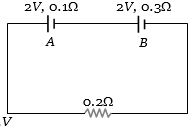
The internal resistances of two cells shown are $0.1\,\Omega $ and $0.3\,\Omega $. If $R = 0.2\,\Omega $, the potential difference across the cell
Total internal reflection is possible when light rays travel
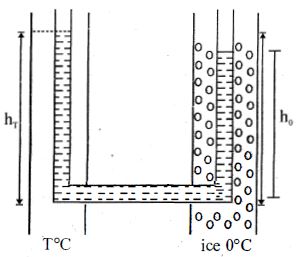
In an experiment to find the liquid expansion coefficient $(\gamma)$ a column. of experimental liquid at $T\,^oC$ is balanced against another column of experimental liquid at $0\, ^o C$ by taking them in $U-$ tube. The expansion coefficient $(\gamma)$ is ?
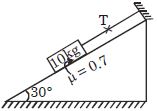
The tension $T$ in the string shown in figure is
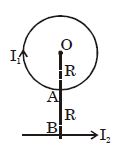
In the diagram, $I_1$ , $I_2$ are the strength of the currents in the loop and infinite long straight conductor respectively. $OA = AB = R$ . The net magnetic field at the centre $O$ is zero. Then the ratio of the currents in the loop and the straight conductor is 
A nucleus of $_{84}^{210}Po$ originally at rest emits $\alpha$ particle with speed $v$. What will be the recoil speed of the daughter nucleus
A uniformly charged ring of radius $3a$ and total charge $q$ is placed in $xy-$ plane centered at origin. A point charge $q$ is moving towards the ring along the $z-$ axis and has speed $v$ at $z = 4a$. The minimum value of $v$ such that it crosses the origin is
The gravitational field in a region is given by

$\vec E$ $=(5\,N / kg)\, \hat i + (12\,N / kg)\,\hat j$

If the potential at the origin is taken to be zero, then the ratio of the potential at the points $(12\,m, 0)$ and $(0, 5\,m)$ is

Tend identical cells each of potential $E$ and internal resistance $r$ are connected in series to form a closed circuit. An ideal voltmeter connected across three cells, will read $...........E$
A metallic ring is uniformly charged as shown in figure. $AC$ and $BD$ are two mutually perpendicular diameters. Electric field due to arc $A B$ to '$O$' is '$E$' is magnitude. What would be the magnitude of electric field at '$O$' due to arc $ABC$ ?
Image