Question
Three circuits, each consisting of a switch $'S\ ’$ and two capacitors, are initially charged, as shown in the figure. After the switch has been closed, in which circuit will the charge on the left$-$hand capacitor $(i)$ increase, $(ii)$ decrease and $(iii)$ remain same? Give reasons.

Answer

$V_L = 3?$ $V_R = 3?$ $(L:$ Left, $R:$ Right$)$
$V_L = 6?$ $V_R = 3?$  
$V_L = 2?$ $V_R= 3?$  
Reasons:
  1. No change $– ($ potential same on both capacitors as $(V_L = V_R).$
  2. Charge on left hand capacitor will decrease$ (V_L > V_R).$
  3. Charge on left hand capacitor will increase $(V_R > V_L).$

Need a full question paper?

Generate a complete, print-ready paper with questions like this in minutes — across 16+ boards, with answer keys.

Start Generating Free

Similar questions

Obtain the first Bohr’s radius and the ground state energy of a muonic hydrogen atom $[$i.e., an atom in which a negatively charged muon $(\mu)$ of mass about $207m_e$ orbits around a proton$].$
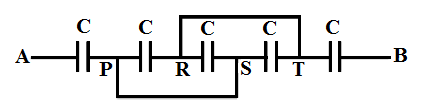
  1. Find equivalent capacitance between A and B in the combination given below. Each capacitor is of 2 μF capacitance.
  1. If a dc source of 7 V is connected across AB, how much charge is drawn from the source and what is the energy stored in the network?
With the help of a simple diagram, explain the working of a silicon solar cell, giving all three basic processes involved. Draw its $I-V$ characteristic.
Two capacitors of capacitance $10\mu\text{F}$ and $20 \mu\text{F}$ are connected in series with a $6 V$ battery. After the capacitors are fully charged, a slab of dielectric constant $(K)$ is inserted between the plates of the two capacitors. How will the following be affected after the slab is introduced:
  1. The electric field energy stored in the capacitors.
  2. The charges on the two capacitors.
  3. The potential difference between the plates of the capacitors.
Justify your answer.
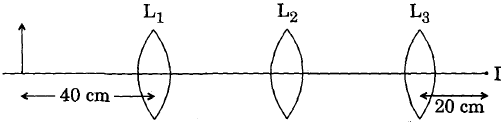
You are given three lenses $L_1, L_2$ and $L_3$ each of focal length $20 \ cm.$ An object is kept at $40 \ cm$ in front of $L_1,$ as shown. The final real image is formed at the focus $I$ of $L_3.$ Find the separations between $L_1, L_2$ and $L_3.$
​​​​​​​
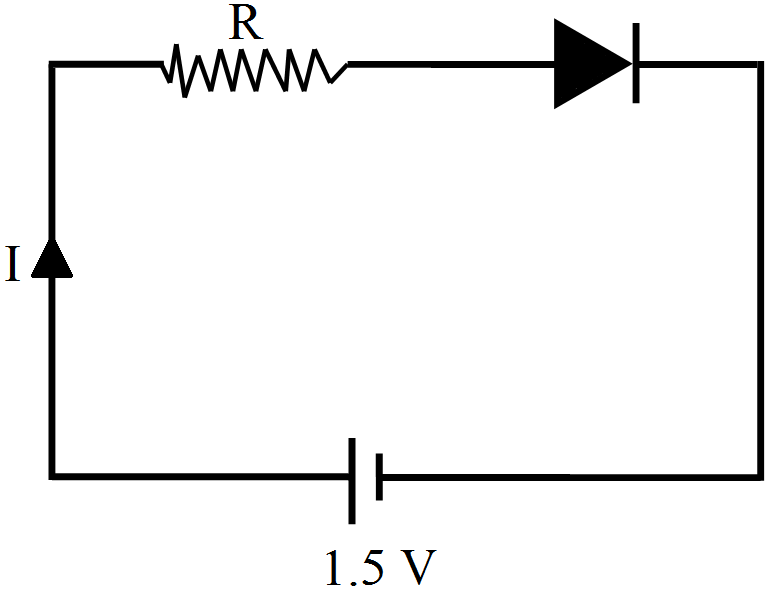
A p-n junction germanium diode when forward biased has a drop of 0.3V which is assumed to be independent of current. The current in excess of 10mA through the diode produces a large Joule-heating which damages (burns) the diode. If we want to use a 1.5V battery to forward-bias the diode, what should be the value of resistor used in series with the diode, so that the maximum current does not exceed 6mA?

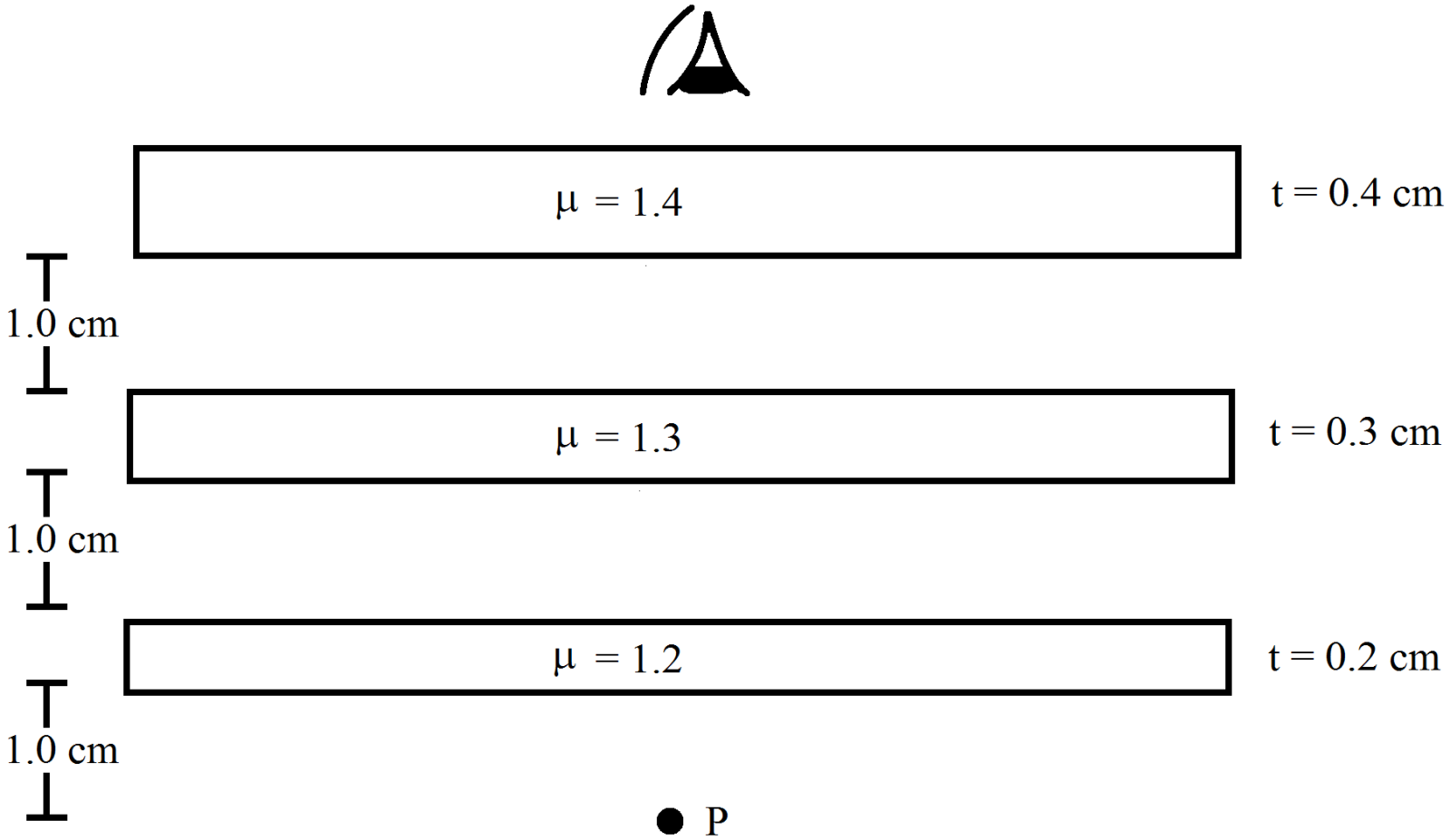
Locate the image of the point P as seen by the eye in the figure.
Explain that Kirchhoff's second law is law of conservation of energy.
Two cells of $\text {EMFs} \ 1 V, 2 V$ and internal resistance $2 \Omega$ and $1 \Omega$ respectively are connected in
$i$. series,
$ii.$ parallel. What should be the external resistance in the circuit so that the current through the resistance be the same in the two cases? In which case, more heat is generated in the cells?
Explain : Bar magnet as an equivalent solenoid.