Question
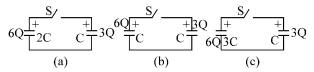
Three circuits, each consisting of a switch ' S ' and two capacitors, are initially charged as shown in the figure. In which circuit, when the switch is closed, the charge on the given capacitor will (i) increase, (ii) decrease and (iii) remain unchanged? Give reason.
Image

Answer

According to the law of conservation of charge, Let $q _1$ and $q _2$, are two charges which are on the left and right side of the capacitor.
$ \left(q_1+q_2\right)_{\text {Beforè }}=\left(q_1^{\prime}+q_2^{\prime}\right)_{\text {After }} $
(a) For the first circuit
$ 6 Q+3 Q=2 CV+CV $
Common potential difference, $V =\frac{9 Q }{3 C }=\frac{3 Q }{ C }$
Value of charge on the left capacitor after closing the switch S .
$q_1^{\prime}=2 CV =2 C \times \frac{3 Q }{ C }$
$q_1^{\prime}=6 Q$
Therefore, the value of charge on the left capacitor remains unchanged.
(b) For the second circuit
$ 6 Q+3 Q=C V+C V $
Common potential difference, $V =\frac{9 Q }{2 C }$
After closing the switch (S) value of the capacitor on the left capacitor
$ \begin{aligned} q_1^{\prime} & =CV \\ & =C \times \frac{9 Q}{2 C}=4.5 Q \end{aligned} $
Therefore, the value of charge on the left capacitor in circuit (b) will decrease.
(c) For the third circuit
$ 6 Q+3 Q=3 C V+C V $
Common potential difference,
$ V=\frac{9 Q}{4 C} $
Value of charge on the left capacitor
$q_1^{\prime}=3 C \times \frac{9 Q }{4 C }=\frac{27 QC }{4 C }$
$q^{\prime}{ }_1=6.75 Q$
Therefore, in circuit (c) the value of the left capacitor will increase.

Need a full question paper?

Generate a complete, print-ready paper with questions like this in minutes — across 16+ boards, with answer keys.

Start Generating Free

Similar questions

"Monochromatic light should be used to produce pure spectrum". Comment on this statement.
Draw the intensity pattern for single slit diffraction and double slit interference. Hence, state two differences between interference and diffraction patterns.
The volume charge density in the space between two conocentric spheres of radii $a$ and $b$ is $\rho=\frac{A}{r}$, where $A$ is a constant and $r$ is the distance. There is a point charge $Q$ at the centre of the sphere. Find the value of A such that there is a uniform electric field in the space between the spheres.
An electron is accelerated through a potential difference of 100 volts. What is the de-Broglie wavelength associated with it? To which part of the electromagnetic spectrum does this value of wavelength correspond?
Two transparent slabs having equal thickness but different refractive indices $\mu_1$ and $\mu_2$ are pasted side by side to form a composite slab. This slab is placed just after the double slit in a Young's experiment so that the light from one slit goes through one material and the light from the other slit goes through the other material. What should be the minimum thickness of the slab so that there is a minimum at the point P0 which is equidistant from the slits?
Give definition of the smallest unit of energy, ev (electron volt) and give its explanation.
Does the phrase "direction of zero vector" have physical significance? Discuss in terms of velocity, force etc.
At what speed the volume of an object shrinks to half its rest value?
From the formula of potential energy of a system of two charges, obtain the equation of P.E. of electric dipole in external electric field.
Explain the reflection of a plane wave using Huygen's principle.