Question
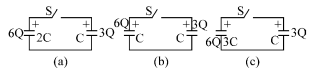
Three circuits, each consisting of a switch ' S ' and two capacitors, are initially charged as shown in the figure. In which circuit, when the switch is closed, the charge on the given capacitor will (i) increase, (ii) decrease and (iii) remain unchanged? Give reason.
Image

Answer

According to the law of conservation of charge, Let $q _1$ and $q _2$, are two charges which are on the left and right side of the capacitor.
$ \left(q_1+q_2\right)_{\text {Beforè }}=\left(q_1^{\prime}+q_2^{\prime}\right)_{\text {After }} $
(a) For the first circuit
$ 6 Q+3 Q=2 CV+CV $
Common potential difference, $V =\frac{9 Q }{3 C }=\frac{3 Q }{ C }$
Value of charge on the left capacitor after closing the switch S .
$q_1^{\prime}=2 CV =2 C \times \frac{3 Q }{ C }$
$q_1^{\prime}=6 Q$
Therefore, the value of charge on the left capacitor remains unchanged.
(b) For the second circuit
$ 6 Q+3 Q=C V+C V $
Common potential difference, $V =\frac{9 Q }{2 C }$
After closing the switch (S) value of the capacitor on the left capacitor
$ \begin{aligned} q_1^{\prime} & =CV \\ & =C \times \frac{9 Q}{2 C}=4.5 Q \end{aligned} $
Therefore, the value of charge on the left capacitor in circuit (b) will decrease.
(c) For the third circuit
$ 6 Q+3 Q=3 C V+C V $
Common potential difference,
$ V=\frac{9 Q}{4 C} $
Value of charge on the left capacitor
$q_1^{\prime}=3 C \times \frac{9 Q }{4 C }=\frac{27 QC }{4 C }$
$q^{\prime}{ }_1=6.75 Q$
Therefore, in circuit (c) the value of the left capacitor will increase.

Need a full question paper?

Generate a complete, print-ready paper with questions like this in minutes — across 16+ boards, with answer keys.

Start Generating Free

Similar questions

A steel ball initially at a pressure of 1.0 × 105Pa is heated from 20°C to 120°C keeping its volume constant. Find the pressure inside the ball. Coefficient of linear expansion of steel = 12 × 10-6 °C-1 and bulk modulus of steel = 1.6 × 10¹¹Nm-2.
Consider a gold nucleus to be a sphere of radius 6.9 fermi in which protons and neutrons are distributed. Find the force of repulsion between two protons situated at largest separation. Why do these protons not fly apart under this repulsion?
How does the energy stored in a capacitor change if the plates of a charged capacitor are moved farther, the battery remaining connected?
Figure shows a wire sliding on two parallel, conducting rails placed at a separation l. A magnetic field B exists in a direction perpendicular to the plane of the rails. What force is necessary to keep the wire moving at a constant velocity v?

Can we physically combine a strip of P-type semiconductor with an N-type semiconductor to form a P-N junction?
Definitions needed to understand reflection from a Spherical mirror :
A spherical surface of radius 30cm separates two transparent media A and B with refractive indices 1.33 and 1.48 respectively. The medium A is on the convex side of the surface. Where should a point object be placed in medium A so that the paraxial rays become parallel after refraction at the surface?
What will be the effect on inductive reactance XL and capacitive reactance XC if frequency of ac source is increased?
Let I = current through a conductor, R = its resistance and V = potential difference across its ends. According to Ohm's law, product of two of these quantities equals the third. Obtain Ohm's law from dimensional analysis. Dimensional formulae for R and V are $\text{ML}^2\text{I}^{-2}\text{T}^{-3}$ and $\text{ML}^2\text{T}^{-3}\text{I}^{-1}$ respectively.
The graph shown here shows the variation of total energy (E) stored in a capacitor against the value of the capacitance (C) itself. Which of the two: the charge on capacitor or the potential used to charge it, is kept constant for this graph?