MCQ
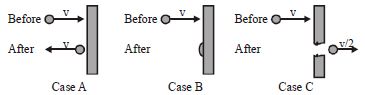
Three different projectiles, each with the same mass, are fired with speed $v$ at a wall. In case $A,$ the projectile bounces straight back with speed $v.$ In case $B$, the projectile sticks to the wall. In case $C$, the projectile crashes through the wall and emerges with half its original speed. These three cases are shown here.

Place the impulse exerted by the wall on the projectile in each of these three cases in the correct order.
  • A
    $A>C>B$
  • B
    $C>B>A$
  • C
    $B>A>C$
  • $A>B>C$

Answer

Correct option: D.
$A>B>C$
d
$\vec {\mathrm{I}}_{\mathrm{aup}}=\vec {\mathrm{p}}_{\mathrm{f}}-\vec {\mathrm{p}}_{\mathrm{i}}$

(1) $\mathrm{I}_{\mathrm{mp}}=2 \mathrm{mv} \leftarrow$

(2) $\mathrm{I}_{\mathrm{mp}}=\mathrm{mv} \leftarrow$

(3) $\mathrm{I}_{\mathrm{mp}}=\frac{\mathrm{mv}}{2} \leftarrow$

Need a full question paper?

Generate a complete, print-ready paper with questions like this in minutes — across 16+ boards, with answer keys.

Start Generating Free

Similar questions

A block of mass $50\, kg$ slides over a horizontal distance of $1\, m$. If the coefficient of friction between their surfaces is $0.2$, then work done against friction is ......... $J$
A man is running with constant speed along a circular path of radius $2 \sqrt 2\, m$. He completes $1$ round in $10\, second$. Find instantaneous speed at $2.5 \,sec.$
A block of mass $m$ lying on a rough horizontal plane is acted upon by a horizontal force $P$ and another force $Q$ inclined at an angle $\theta $ to the vertical. The block will remain in equilibrium, if the coefficient of friction between it and the surface is
A ball of mass $50 \,g$ is dropped from a height of $20 \,m$. A boy on the ground hits the ball vertically upwards with a bat with an average force of $200 \,N$, so that it attains a vertical height of $45 \,m$. The time for which the ball remains in contact with the bat is ........... of a second [Take $g=10 \,m / s ^2$ ]
The focal length of a converging lens are fv and fr for violet and red light respectively:
  1. fv > fr
  2. fv - fr
  3. fv < fr
  4. Any of the three is possible depending on the value of the average refractive index $\mu$.
What will be the formula of mass of the earth in terms of $g, R$ and $G$ ?
A block is placed on a horizontal plank. The plank is performing $SHM$ along a vertical line with amplitude of $40\,cm.$ The block just loses contact with the plank when the plank is momentarily at rest. Then :
A jar contains a gas and few drops of water at $T K.$ The pressure in the jar is $830 \,mm$ of mercury. The temperature of jar is reduced by $1\%.$ The saturated vapour pressure of water at the two temperatures are $30 \,mm$ and $ 25\, mm$ of mercury. Then the new pressure in the jar will be ..... $mm$ of $Hg$
The figure represents the instantaneous picture of a transverse harmonic wave traveling along the negative $x$-axis. Choose the correct alternative $(s)$ related to the movement of the nine points shown in the figure.  The points moving downwards is/are
$A$ block of mass $m$ slides down a plane inclined at an angle $\theta$ . Which of the following will $NOT$ increase the energy lost by the block due to friction?