MCQ
Three equal weights $A, B$ and $C$ of mass $2 kg$ each are hanging on a string passing over a fixed frictionless pulley as shown in the figure The tension in the string connecting weights $B$ and $C$ is
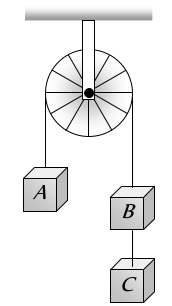
  • A
    Zero
  • $13 N$
  • C
    $3.3 N$
  • D
    $19.6 N$

Answer

Correct option: B.
$13 N$

Need a full question paper?

Generate a complete, print-ready paper with questions like this in minutes — across 16+ boards, with answer keys.

Start Generating Free

Similar questions

The resistance of a galvanometer is $50 \mathrm{ohms}$ and the current required to give full scale deflection is $100 \mu \mathrm{A}$. In order to convert it into an ammeter, reading upto $10 A$, it is necessary to put a resistance of
Which of following can not be polarised
A source of sound is moving with constant velocity of $20 \mathrm{~m} / \mathrm{s}$ emitting a note of frequency $1000 \mathrm{~Hz}$. The ratio of frequencies observed by a stationary observer while the source is approaching him and after it crosses him will be(Speed of sound $v=340 \mathrm{~m} / \mathrm{s}$ )
The inductance of a coil is $60 \mu \mathrm{H}$. A current in this coil increases from $1.0 A$ to $1.5 A$ in $0.1$ second. The magnitude of the induced e.m.f. is
In the above question, the ratio of the increase in energy of the wire to the decrease in gravitational potential energy when load moves downwards by $1 mm$, will be
A closed bottle containing water at $30^{\circ} \mathrm{C}$ is carried to the moon in a space-ship. If it is placed on the surface of the moon, what will happen to the water as soon as the lid is opened
Water drops fall at regular intervals from a tap which is $5 m$ above the ground. The third drop is leaving the tap at the instant the first drop touches the ground. How far above the ground is the second drop at that instant
A person wears glasses of power $-2.0 \mathrm{D}$. The defect of the eye and the far point of the person without the glasses will be
A body of mass $5 \mathrm{~kg}$ moving with a velocity $10 \mathrm{~m} / \mathrm{s}$ collides with another body of the mass $20 \mathrm{~kg}$ at, rest and comes to rest. The velocity of the second body due to collision is
When two sound waves with a phase difference of $\pi / 2$, and each having amplitude $A$ and frequency $\omega$, are superimposed on each other, then the maximum amplitude and frequency of resultant wave is