MCQ
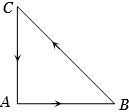
Three forces starts acting simultaneously on a particle moving with velocity $\vec v.$ These forces are represented in magnitude and direction by the three sides of a triangle $ABC$ (as shown). The particle will now move with velocity
  • $\overrightarrow {v\,} $ remaining unchanged
  • B
    Less than $\overrightarrow {v\,} $
  • C
    Greater than $\overrightarrow {v\,} $
  • D
    $\overrightarrow {v\,} $ in the direction of the largest force $BC$
Answer

Correct option: A.
$\overrightarrow {v\,} $ remaining unchanged
a
(a)Net force on the particle is zero so the $\overrightarrow v $ remains unchanged.

Need a full question paper?

Generate a complete, print-ready paper with questions like this in minutes — across 16+ boards, with answer keys.

Start Generating Free

Similar questions

At what temperature the molecules of nitrogen will have the same $r.m.s.$ velocity as the molecules of oxygen at $127°C$  ....... $^oC$
A stone drop from height $'h\ '$ on Earth surface fall in $1\sec.$ If the same stone taken to Moon and drop freely then it will reaches from the surface of the Moon in the time $($The $'g\ '$ of Moon is $1/6$ times of Earth$):-$
A child of mass $5\,kg$ is going round a merry-goround that makes $1$ rotation in $3.14\,s$. The radius of the merry-go-round is $2\,m$. The centrifugal force on the child will be $.......\,N$
If the law of gravitation, instead of being inversesquare law, becomes an inversecube law.
A uniform narrow $1.95\,\, m$ long pipe is open at both ends. It resonates at two successive harmonic of frequency $275\,\, Hz$ and $330 \,Hz.$The speed of sound in the tube is ...... $m/s$
Consider following statements

$[1]$ $CM$ of a uniform semicircular disc of radius $R = 2R/\pi$ from the centre

$[2]$ $CM$ of a uniform semicircular ring of radius $R = 4R/3 \pi$ from the centre

$[3]$ $CM$ of a solid hemisphere of radius $R = 4R/3 \pi$ from the centre

$[4]$ $CM$ of a hemisphere shell of radius $R = R/2$ from the centre Which statements are correct?

Consider $P-V$ diagram for an ideal gas shown in:

Out of the following diagrams which represents the $T-P$ diagram?
A Carnot’s engine is made to work between $200°C$ and $0°C$ first and then between $0°C$ and $-200°C.$ The ratio of efficiencies of the engine in the two cases is
A man carries a load on his head through a distance of $5 \,m$. The maximum amount of work is done when he ..........
A person is standing on an open car moving with a constant velocity of $30\,\,m/s$  on a straight horizontal road. The man throws a ball in the vertically upward direction and it returns to the person after the car has moved $240\,\,m.$  The speed and the angle of projection