Question
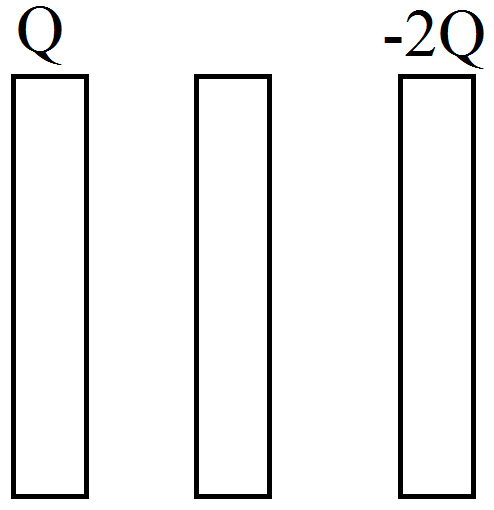
Three identical metal plates with large surface areas are kept parallel to each other as shown in figure. The leftmost plate is given a charge Q, the rightmost a charge -2Q and the middle one remains neutral. Find the charge appearing on the outer surface of the rightmost plate.
Answer


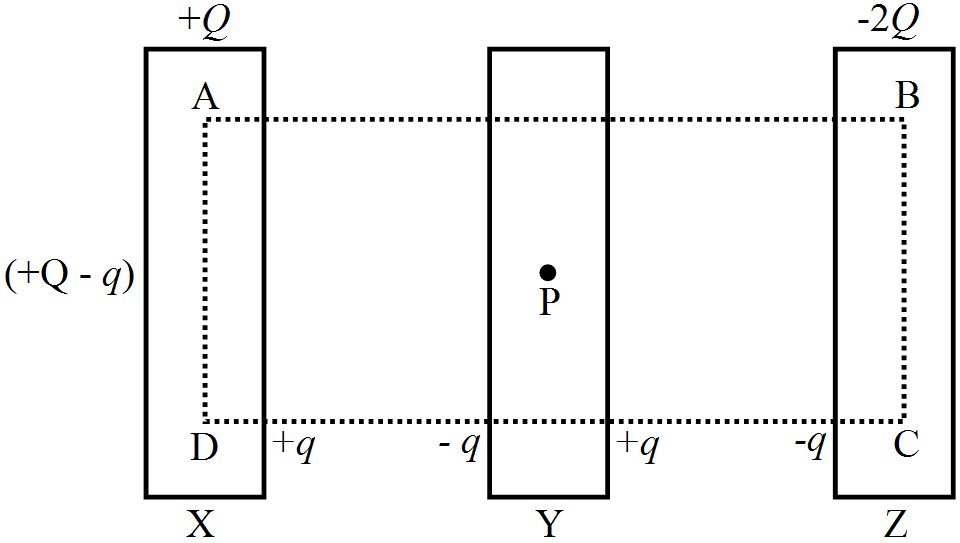
Consider the Gaussian surface as shown in the figure.
Let the charge on the outer surface of the left-most plate be q. Thus, the charges on the plates are distributed as shown in the diagram.
The net field at point P due to all the induced charges must be zero, as it is lying inside the metal surface.
Let the surface area of the plates be A.
Electric field at point P due to the charges on plate X:
Due to charge (+Q - q) is $\frac{\text{Q}-\text{q}}{2\text{A}\epsilon_0}$ in the right direction
Due to charge (+q) is $\frac{\text{q}}{2\text{A}\epsilon_0}$ in the right direction
Electric field at point P due to charges on plate Y:
Due to charge (-q) is $\frac{\text{q}}{2\text{A}\epsilon_0}$ in the right direction
Due to charge (+q) is $\frac{\text{q}}{2\text{A}\epsilon_0}$ in the left direction
Electric field at point P due to charges on plate Z:
Due to charge (-q) is $\frac{\text{q}}{2\text{A}\epsilon_0}$ in the right direction
Due to charge (-2Q + q) is $\frac{\text{2Q}-\text{q}}{2\text{A}\epsilon_0}$ in the right direction
The net electric field at point P:
$\frac{\text{Q}-\text{q}}{2\text{a}\epsilon_0}+\frac{\text{q}}{2\text{A}\epsilon_0}-\frac{\text{q}}{2\text{A}\epsilon_0}-\frac{\text{q}}{2\text{A}\epsilon_0}+\frac{\text{q}}{2\text{A}\epsilon_0}+\frac{\text{2Q}-\text{q}}{2\text{A}\epsilon_0}=0$
$\frac{\text{Q}-\text{q}}{2\text{A}\epsilon_0}+\frac{\text{2Q}-\text{q}}{2\text{A}\epsilon_0}=0$
$\text{Q}-\text{q}+\text{2Q}-\text{q}=0$
$\text{3Q}-2\text{q}=0$
$\text{q}=\frac{\text{3Q}}{2}$
Thus, the charge on the outer plate of the right-most plate
$-2\text{Q}+\text{q}=-2\text{Q}+\frac{3\text{Q}}{2}=-\frac{\text{Q}}{2}$

Need a full question paper?

Generate a complete, print-ready paper with questions like this in minutes — across 16+ boards, with answer keys.

Start Generating Free

Similar questions

The wavelength of a probe is roughly a measure of the size of a structure that it can probe in some detail. The quark structure of protons and neutrons appears at the minute length$-$scale of $10^{–15} m$ or less. This structure was first probed in early $1970’s$ using high energy electron beams produced by a linear accelerator at Stanford, $\text{USA.}$ Guess what might have been the order of energy of these electron beams. $($Rest mass energy of electron $= 0.511\ MeV.)$
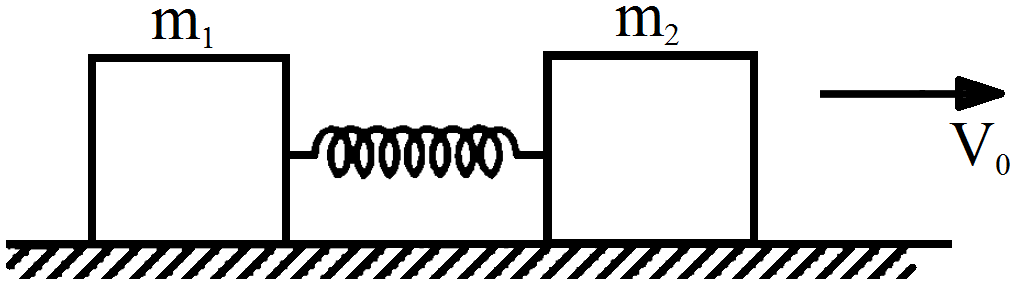
Two blocks of masses $m_1$ and $m_2$ are connected by a spring of spring constant $k.$ The block of mass $m_2$ is given a sharp impulse so that it acquires a velocity $v_0$ towards right. Find
  1. The velocity of the centre of mass.
  2. The maximum elongation that the spring will suffer.
  1. Mention two properties of soft iron due to which it is preferred for making an electromagnet.
  2. State Gauss's law in magnetism. How is it different from Gauss's law in electrostatics and why?
A person looks at different trees in an open space with the following details. Arrange the trees in decreasing order of their apparent sizes.
Tree Height(m) Distance form the eye(m)
A 2.8 50
B 2.5 80
C 1.8 70
D 2.8 100
A spherical volume contains a uniformly distributed charge of density $2.0 \times 10^{-4}Cm^{-3}.$ Find the electric field at a point inside the volume at a distance $4.0\ cm$ from the centre.
A cylinder rotating at an angular speed of $50\ce{ rev/s}$ is brought in contact with an identical stationary cylinder. Because of the kinetic friction, torques act on the two cylinders, accelerating the stationary one and decelerating the moving one. If the common magnitude of the acceleration and deceleration be one revolution per second square, how long will it take before the two cylinders have equal angular speed?
A plate of area $10\ cm^2$ is to be electroplated with copper $($density $9000\ kg/m^3)$ to a thickness of $10$ micrometres on both sides, using a cell of $12V$. Calculate the energy spent by the cell in the process of deposition. If this energy is used to heat $100g$ of water, calculate the rise in the temperature of the water. $\ce{ECE}$ of copper $= 3 \times 10^{-7}kg C^1 $ and specific heat capacity of water $= 4200Jkg^1.$
A positive ion having just one electron ejects it if a photon of wavelength $288\mathring{\text{A}}$ or less is absorbed by it. Identify the ion.
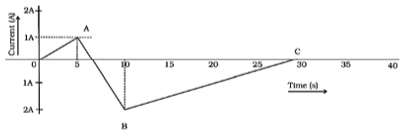
$A ($current vs time$)$ graph of the current passing through a solenoid is shown in Figure. For which time is the back electromotive force $(u)$ a maximum. If the back emf at $t = 3s$ is $e,$ find the back emf at $t = 7 s, 15s,$ and $40s. OA, AB,$ and $BC$ are straight line segments.
Image
A block A can slide on a frictionless incline of angle $\theta$ and length l, kept inside an elevator going up with uniform velocity v. Find the time taken by the block to slide down the length of the incline if it is released from the top of the incline.