Question
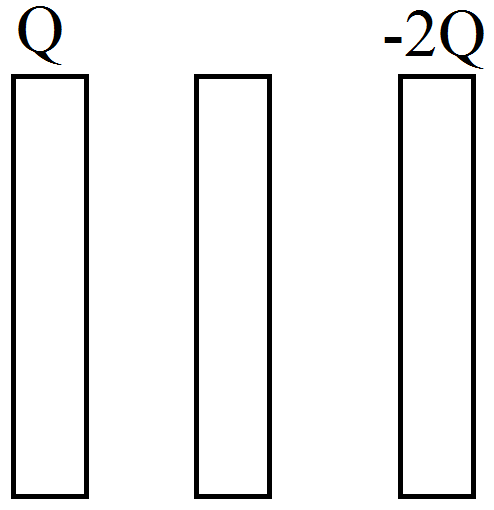
Three identical metal plates with large surface areas are kept parallel to each other as shown in figure. The leftmost plate is given a charge Q, the rightmost a charge -2Q and the middle one remains neutral. Find the charge appearing on the outer surface of the rightmost plate.
Answer


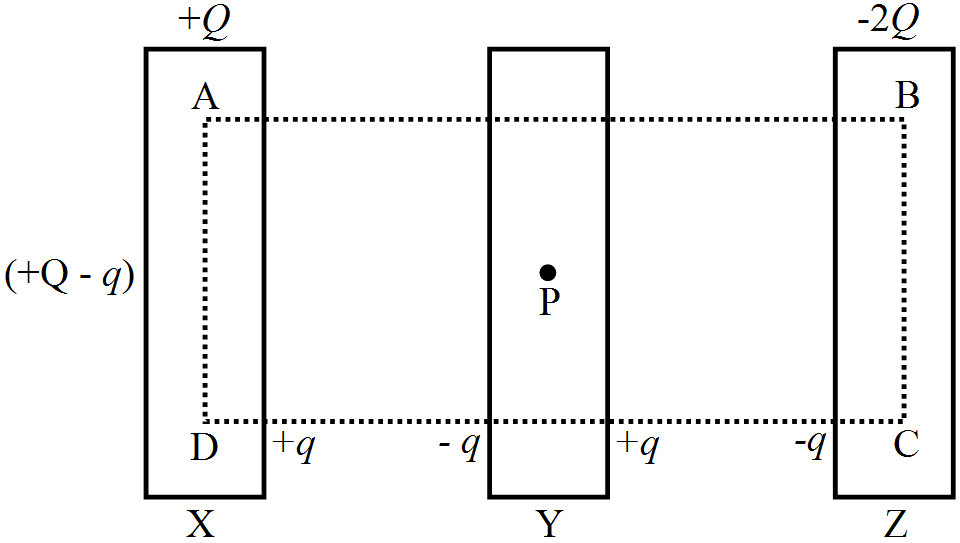
Consider the Gaussian surface as shown in the figure.
Let the charge on the outer surface of the left-most plate be q. Thus, the charges on the plates are distributed as shown in the diagram.
The net field at point P due to all the induced charges must be zero, as it is lying inside the metal surface.
Let the surface area of the plates be A.
Electric field at point P due to the charges on plate X:
Due to charge (+Q - q) is $\frac{\text{Q}-\text{q}}{2\text{A}\in_0}$ in the right direction
Due to charge (+q) is $\frac{\text{q}}{2\text{A}\in_0}$ in the right direction
Electric field at point P due to charges on plate Y:
Due to charge (-q) is $\frac{\text{q}}{2\text{A}\in_0}$ in the right direction
Due to charge (+q) is $\frac{\text{q}}{2\text{A}\in_0}$ in the left direction
Electric field at point P due to charges on plate Z:
Due to charge (-q) is $\frac{\text{q}}{2\text{A}\in_0}$ in the right direction
Due to charge (-2Q + q) is $\frac{\text{2Q}-\text{q}}{2\text{A}\in_0}$ in the right direction
The net electric field at point P:
$\frac{\text{Q}-\text{q}}{2\text{a}\in_0}+\frac{\text{q}}{2\text{A}\in_0}-\frac{\text{q}}{2\text{A}\in_0}-\frac{\text{q}}{2\text{A}\in_0}+\frac{\text{q}}{2\text{A}\in_0}+\frac{\text{2Q}-\text{q}}{2\text{A}\in_0}=0$
$\frac{\text{Q}-\text{q}}{2\text{A}\in_0}+\frac{\text{2Q}-\text{q}}{2\text{A}\in_0}=0$
$\text{Q}-\text{q}+\text{2Q}-\text{q}=0$
$\text{3Q}-2\text{q}=0$
$\text{q}=\frac{\text{3Q}}{2}$
Thus, the charge on the outer plate of the right-most plate
$-2\text{Q}+\text{q}=-2\text{Q}+\frac{3\text{Q}}{2}=-\frac{\text{Q}}{2}$

Need a full question paper?

Generate a complete, print-ready paper with questions like this in minutes — across 16+ boards, with answer keys.

Start Generating Free

Similar questions

Reynold's number $N_R$(a dimensionless quantity) determines the condition of laminar flow of a viscous liquid through a pipe. $N_R$ is a function of the density of the liquid 'r', its average speed is 'y' and the coefficient of viscosity of the liquid is 'h'. If N, is given directly proportional to 'd' (the diameter of the pipe), show from dimensional consideration that $\text{N}_\text{R}\propto \frac{\text{dp}\rho}{\eta}$ the unit of '$\eta$' in SI system is kg $m^{-1}s^{-1}​​​​​​​$?
A nonconducting sheet of large surface area and thickness d contains uniform charge distribution of density $\rho.$ Find the electric field at a point P inside the plate, at a distance x from the central plane. Draw a qualitative graph of E against x for 0 < x < d.
The specific heat capacities of hydrogen at constant volume and at constant pressure are $2.4 \mathrm{cal}^{-} \mathrm{g}^{-1}{ }^{\circ} \mathrm{C}^{-1}$ and $3.4 \mathrm{cal}-$ $\mathrm{g}^{-1}{ }^{\circ} \mathrm{C}^{-1}$ respectively. The molecular weight of hydrogen is $2 \mathrm{~g}-\mathrm{mol}^{-1}$ and the gas constant, $\mathrm{R}=8.3 \times 10^7 \mathrm{erg}^{\circ} \mathrm{C}^{-1} \mathrm{~mol}^{-}$ ${ }^1$. Calculate the value of $J$.
A cylindrical vessel of uniform cross-section contains liquid upto a height 'H'. At a depth $'\text{h}'=\frac{\text{H}}{2}$ below the free surface of the liquid there is an orifice. Using Bernoulli's theorem, find the velocity of efflux of liquid.
Light from a massive star suffers 'gravitational red shift' i.e., its wavelength changes towards the red end due to the gravitational attraction of the star. Obtain the formula for this gravitational red shift using the simple consideration that a photon of frequency v has energy $\text{h}\nu$ (h=planck's constant) and mass $\frac{\text{h}\nu}{\text{c}^2}.$ Estimate the magnitude of the red-shift for light of wavelength $5000\mathring{\text{A}}$ from a star of mass $10^{32}kg$ and radius $10^6km. G = 6.67 \times 10^{-11}Nm^2 kg^{-2}$ and $C = 3 \times 108m s^{-1}$.
A convex lens produces a double size real image when an object is placed at a distance of 18cm from it. Where should the object be placed to produce a triple size real image?
If the time of flight of a projectile projected with a velocity u at an angle $\theta$ is $\frac{2\text{u}\sin\theta}{\text{g}},$ find the condition for maximum range and its value?
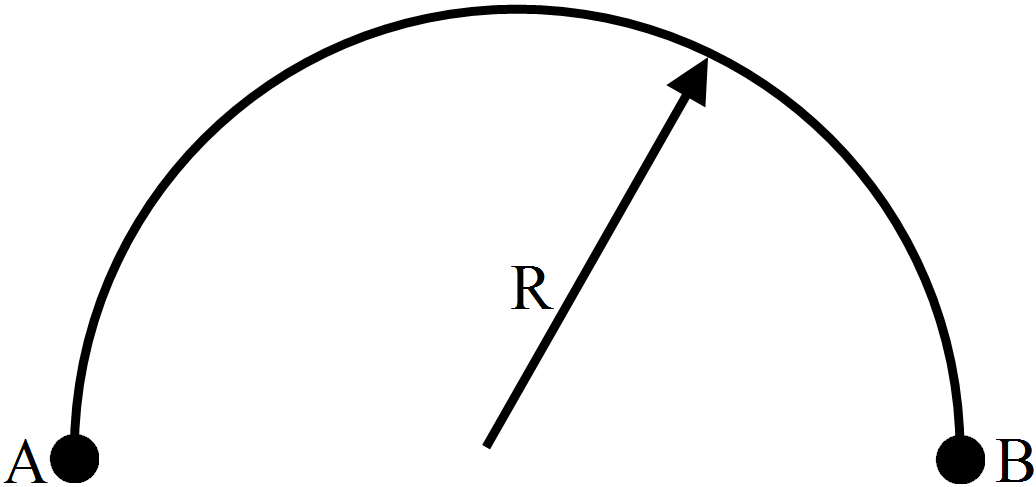
A particle moves along a semicircular path of radius $R$ in time $t$ with constant speed. For particle calculate:
  1. Distance travelled.
  2. Displacement.
  3. Average speed.
  4. Average velocity.
  5. Average acceleration.
For a glass prism of refracting angle 60°, the minimum angle of deviation $D_m$ is found to be 36° with a maximum error of 1.05°. When a beam of parallel light is incident on the prism, find the range of experimental value of refractive index $'μ'.$ It is known that the refractive index $'μ'$ of the material of the prism is given by: $\mu=\frac{\sin\Big(\frac{\text{A}+\text{D}_\text{m}}{2}\Big)}{\sin\frac{\text{A}}{2}}$
Define thermal conduction. Briefly explain its molecular mechanism.