Question
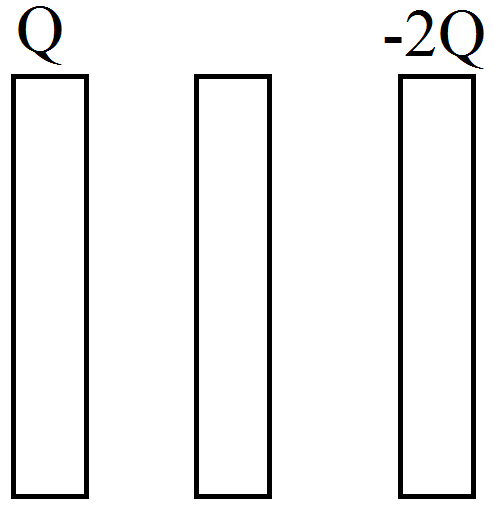
Three identical metal plates with large surface areas are kept parallel to each other as shown in figure. The leftmost plate is given a charge Q, the rightmost a charge -2Q and the middle one remains neutral. Find the charge appearing on the outer surface of the rightmost plate.
Answer


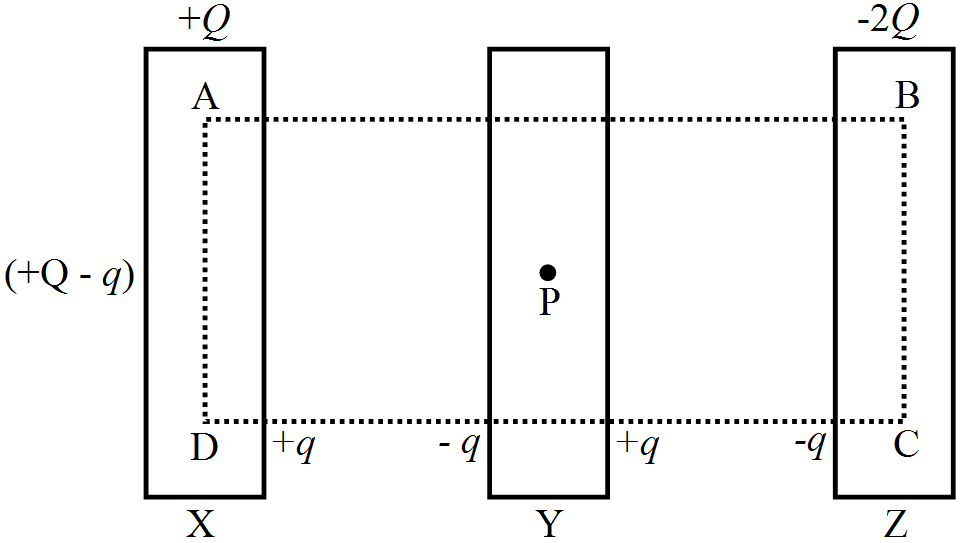
Consider the Gaussian surface as shown in the figure.
Let the charge on the outer surface of the left-most plate be q. Thus, the charges on the plates are distributed as shown in the diagram.
The net field at point P due to all the induced charges must be zero, as it is lying inside the metal surface.
Let the surface area of the plates be A.
Electric field at point P due to the charges on plate X:
Due to charge (+Q - q) is $\frac{\text{Q}-\text{q}}{2\text{A}\in_0}$ in the right direction
Due to charge (+q) is $\frac{\text{q}}{2\text{A}\in_0}$ in the right direction
Electric field at point P due to charges on plate Y:
Due to charge (-q) is $\frac{\text{q}}{2\text{A}\in_0}$ in the right direction
Due to charge (+q) is $\frac{\text{q}}{2\text{A}\in_0}$ in the left direction
Electric field at point P due to charges on plate Z:
Due to charge (-q) is $\frac{\text{q}}{2\text{A}\in_0}$ in the right direction
Due to charge (-2Q + q) is $\frac{\text{2Q}-\text{q}}{2\text{A}\in_0}$ in the right direction
The net electric field at point P:
$\frac{\text{Q}-\text{q}}{2\text{a}\in_0}+\frac{\text{q}}{2\text{A}\in_0}-\frac{\text{q}}{2\text{A}\in_0}-\frac{\text{q}}{2\text{A}\in_0}+\frac{\text{q}}{2\text{A}\in_0}+\frac{\text{2Q}-\text{q}}{2\text{A}\in_0}=0$
$\frac{\text{Q}-\text{q}}{2\text{A}\in_0}+\frac{\text{2Q}-\text{q}}{2\text{A}\in_0}=0$
$\text{Q}-\text{q}+\text{2Q}-\text{q}=0$
$\text{3Q}-2\text{q}=0$
$\text{q}=\frac{\text{3Q}}{2}$
Thus, the charge on the outer plate of the right-most plate
$-2\text{Q}+\text{q}=-2\text{Q}+\frac{3\text{Q}}{2}=-\frac{\text{Q}}{2}$

Need a full question paper?

Generate a complete, print-ready paper with questions like this in minutes — across 16+ boards, with answer keys.

Start Generating Free

Similar questions

  1. Three resistors $2\ \Omega,\ 4\ \Omega\ \text{and}\ 5\ \Omega$ are combined in parallel. What is the total resistance of the combination?
  2. If the combination is connected to a battery of emf 20 V and negligible internal resistance, determine the current through each resistor, and the total current drawn from the battery.
Write Einstein’s photoelectric equation and point out any two characteristic properties of photons on which this equation is based.
Briefly, explain the three observed features which can be explained by this equation.
The speed of sound in air is 332m/s. Is it advisable to define the length 1m as the distance travelled by sound in $\frac{1}{332}\text{s}$?
Estimate the number of electrons in 100g of water. How much is the total negative charge on these electrons?
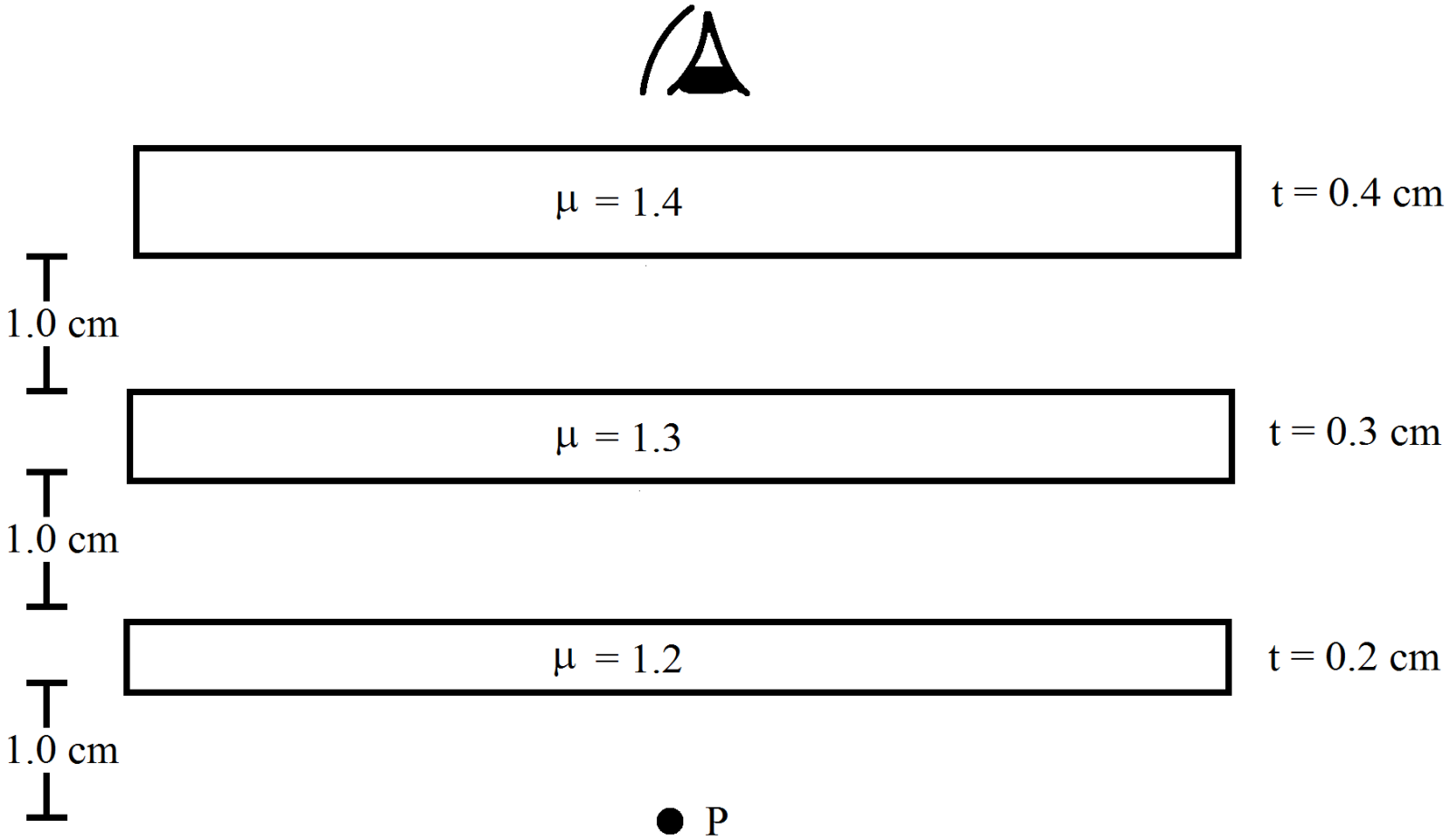
Locate the image of the point P as seen by the eye in the figure.
Figure, shows a string stretched by a block going over a pulley. The string vibrates in its tenth harmonic in unison with a particular tuning fork. When a beaker containing water is brought under the block so that the block is completely dipped into the beaker, the string vibrates in its eleventh harmonic. Find the density of the material of the block.
Why is the diffraction of sound waves more evident in daily experience than that of light wave?
Two insulating small spheres are rubbed against each other and placed 1cm apart. If they attract each other with a force of 0.1N, how many electrons were transferred from one sphere to the other dunng rubbing?
State Lenz's law. Give one example to illustrate this law. "The Lenz's law is a consequence of the principle of conservation of energy." Justify this statement.
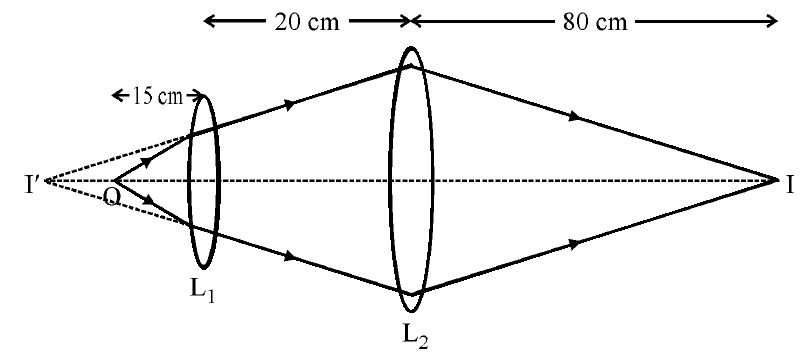
In the following diagram, an object ‘O’ is placed 15 cm in front of a convex lens $L_1$ of focal length 20 cm and the final image is formed at ‘I’ at a distance of 80 cm from the second lens $L_2.$ Find the focal length of the lens $L_2.$​​​​​​​