Question
Three integers are chosen at random from the first 20 integers. The probability that their product is even is,
  1. $\frac{2}{19}$
  2. $\frac{3}{29}$
  3. $\frac{17}{19}$
  4. $\frac{4}{19}$

Answer

  1. $\frac{17}{19}$
Soluction:
Required probability that product of two integers should be even.
10 integers are odd out of first 20 integers.
Required probability = 1 - Probability of product is odd
Product of three integers is odd if two numbers are odd
Required probability $=1-\frac{10}{20}\times\frac{9}{19}\times\frac{8}{18}=\frac{17}{19}$

Need a full question paper?

Generate a complete, print-ready paper with questions like this in minutes — across 16+ boards, with answer keys.
Start Generating Free

Similar questions

If two constraints do not intersect in the positive quadrant of the graph, then.
Minimise $\text{Z}=\sum\limits^{\text{n}}_{\text{j}=1}\sum\limits^{\text{m}}_{\text{i}=1}\text{c}_{\text{ij}}\cdot\text{x}_{\text{ij}}$ Subject to $\sum\limits^{\text{m}}_{\text{i}=1}\text{x}_{\text{ji}}=\text{b}_{\text{j}},\text{j}=1,2,....\text{n}$ $\sum\limits^{\text{n}}_{\text{j}=1}\text{x}_{\text{ji}}=\text{b}_{\text{j}},\text{j}=1,2,.....,\text{m}$  is a $LPP$ with number of constraints.
Order of $\Big(\frac{\text{dy}}{\text{dx}}+3\text{x}\Big)^\frac{3}{2}=\text{x}+\frac{3\text{dy}}{\text{dx}}$ is:
  1. 3
  2. 2
  3. 1
  4. 4
The inverse of the matrix $A=\left[\begin{array}{ccc}1 & -1 & 1 \\ 2 & 3 & 0 \\ 18 & 2 & 10\end{array}\right]$
If $R =\left\{(x, y): x, y \in Z , x^2+y^2 \leq 4\right\}$ is a relation in Z then domain of R is :
Evaluate $\begin{bmatrix}5&-4\\1&\sqrt{3}\end{bmatrix}$
  1. $4\sqrt{3}+4$
  2. $4\sqrt{3}+5$
  3. $5\sqrt{3}+4$
  4. $4\sqrt{3}-4$
Choose the correct answer from the given four options.

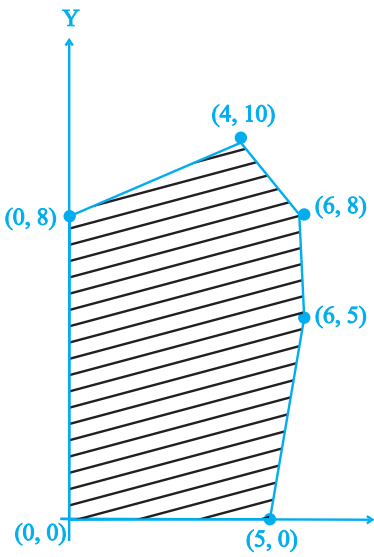
The feasible solution for a LPP shown in Fig. 12.12. Let z = 3x - 4y be objective functio. (Maximum value of Z + Minimum value of Z) is equal to:
Mark the correct alternative in the following question:Which one is not a requirement of a binomial dstribution?
  1. There are 2 outcomes for each trial.
  2. There is a fixed number of trials.
  3. The outcomes must be dependent on each other.
  4. The probability of success must be the same for all the trials.
The domain of $\sin ^{-1} x+\cos ^{-1} x+\tan ^{-1} x$ is
To write the dual; it should be ensured that
  1.  All the primal variables are non - negative.
  2. All the bi values are non - negative.
  3. All the constraints are $\leq$ type if it is maximization problem and $\geq$ type if it is a minimization problem.
  1. I and II
  2. II and III
  3. I and III
  4. I, II and IIl