Question

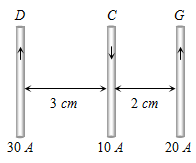
Three long, straight parallel wires carrying current, are arranged as shown in figure. The force experienced by a 25 cm length of wire C is
(a) 10-3 N

(b) 2.5 ×10⁻³ N

(c) Zero

(d) 1.5 × 10⁻³ N

Answer

(c) Zero

Need a full question paper?

Generate a complete, print-ready paper with questions like this in minutes — across 16+ boards, with answer keys.

Start Generating Free

Similar questions

A constant voltage is applied between the two ends of a uniform metallic wire. Some heat is developed in it. The heat developed is doubled if.
A coil has an inductance of 0.7 H and is joined in series with a resistance of $220\Omega$ When an alternating emf of 220V at 50 cps is applied to it, then the wattless component of the current in the circuit is $(\text{take }0.7\pi=2.2)$

If   undergoes successively 8 a-decays and 6 b-decays, then resulting nucleus is

(a)  

(b)  

(c)  

(d)  

When 2 amperes current is passed through a tangent galvanometer, it gives a deflection of 30o. For 60o deflection, the current must be

(a) 1 amp

(b) 2 

(c) 4 amp 

(d) 6 amp

The diode shown in the circuit is a silicon diode. The potential difference between the points A and B will be

(a) 6 V

(b) 0.6 V

(c) 0.7 V

(d) 0 V

With rise in temperature resistivity of an intrinsic semiconductor :

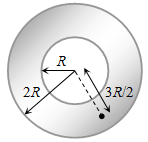
Figure shows the cross-sectional view of the hollow cylindrical conductor with inner radius 'R' and outer radius '2R', cylinder carrying uniformly distributed current along it's axis. The magnetic induction at point 'P' at a distance  from the axis of the cylinder will be

(a) Zero

(b)  

(c)

(d)

The current flowing in two coaxial coils in the same direction. On increasing the distance between the two, the electric current will

(a)  Increase

(b)  Decrease

(c)  Remain unchanged

(d)  The information is incomplete

In an LCR series a.c. circuit, the voltage across each of the components. L, C and R is 50V. The voltage across the LC combination will be:

Angle of a prism is 30° and its refractive index is  and one of the surface is silvered. At what angle of incidence, a ray should be incident on one surface so that after reflection from the silvered surface, it retraces its path

(a) 30°

(b) 60°

(c) 45°

(d)