MCQ
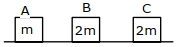
Three objects $A, B$ and $C$ are kept in a straight line on a frictionless horizontal surface. The masses of ${A}, {B}$ and ${C}$ are ${m}, 2\, {m}$ and $2\, {m}$ respectively. $A$ moves towards ${B}$ with a speed of $9$ ${m} / {s}$ and makes an elastic collision with it. Thereafter $B$ makes a completely inelastic collision with $C.$ All motions occur along same straight line. The final speed of $C$ is $....\,{m} / {s}$
  • $4$
  • B
    $6$
  • C
    $9$
  • D
    $3$

Answer

Correct option: A.
$4$
a
After $1^{st}$ collision

$m v_{A}=m v_{A}^{\prime}+2 m v_{B}^{\prime}$

$-1=\frac{v_{B}^{\prime}-v_{A}^{\prime}}{0-v_{A}} \Rightarrow v_{B}^{\prime}=6 m / s$

After the $2^{nd}$ collision

$2 mv _{ B }^{\prime}=(2 m + m )_{ V _{ C }}$

$\Rightarrow v _{ C }=\frac{2}{3} v _{ B }^{\prime} \Rightarrow v _{ C }=4 m / s$

Need a full question paper?

Generate a complete, print-ready paper with questions like this in minutes — across 16+ boards, with answer keys.

Start Generating Free

Similar questions

A weightless thread can bear a tension upto $3.7\,kg-wt$ . A stone of mass $500\,g$ is tied to it and revolved in a circular path of radius $4\,m$ in a vertical plane. If $g = 10\,ms^{-2}$, then the maximum angular velocity of the stone will be ......... $rad\,s^{-1}$
A person can jump higher on the lunar surface than on the earth's surface because:
A particular star (assuming it as a black body) has a surface temperature of about $5 \times {10^4}K.$The wavelength in nanometers at which its radiation becomes maximum is $(b = 0.0029 mK)$
Two persons of equal height are carrying a long uniform wooden beam of length $\ell $. They are at distance  $\frac{\ell }{5}$ and $\frac{\ell }{3}$ . From nearest end of the rod. The ratio of normal reaction at their heads is
A cylindrical vessel of height $500 \mathrm{~mm}$ has an orifice (small hole) at its bottom. The orifice is initially closed and water is filled in it up to height $\mathrm{H}$. Now the top is completely sealed with a cap and the orifice at the bottom is opened. Some water comes out from the orifice and the water level in the vessel becomes steady with height of water column being $200 \mathrm{~mm}$. Find the fall in height (in ${m m}$ ) of water level due to opening of the orifice.

|Take atmospheric pressure $=1.0 \times 10^5 \mathrm{~N} / \mathrm{m}^2$, density of water $=1000 \mathrm{~kg} / \mathrm{m}^3$ and $g=10 \mathrm{~m} / \mathrm{s}^2$. Neglect any effect of surface tension.]

Two unequal masses are tied together with a cord with a compressed spring in between. When the cord is burnt with a match releasing the spring, the two masses fly apart with equal
Let $T_1$ and $T_2$ be the time periods of two springs $A$ and $B$ when a mass $m$ is suspended from them separately. Now both the springs are connected in parallel  and same mass $m$ is suspended with them. Now let $T$ be the time period in this position. Then
A solid cylinder of length $L$ and radius $r$ is heat upto same temperature as that of a cube of edge length $a$. If both have same material, volume and allowed to cool under similar conditions, then ratio of amount of radiations radiated will be (Neglect radiation emitted from flat surfaces of the cylinder)
The dimension of $\frac{1}{2} \varepsilon_0 E ^2$, where $\varepsilon_0$ is permittivity of free space and $E$ is electric field, is
Three different objects of masses ${m_1},{m_2}$ and ${m_3}$ are allowed to fall from rest and from the same point $‘O’$ along three different frictionless paths. The speeds of the three objects, on reaching the ground, will be in the ratio of