Question

Three resistors each of 2 ohm are connected together in a triangular shape. The resistance between any two vertices will be

(a) 4/3 ohm

(b) 3/4 ohm

(c) 3 ohm  

(d) 6 ohm

Answer

(a) 4/3 ohm

Need a full question paper?

Generate a complete, print-ready paper with questions like this in minutes — across 16+ boards, with answer keys.

Start Generating Free

Similar questions

The magnitude of magnifying power of an astronomical telescope is 5, the focal power of its eyepiece is 10 diopters. The focal power of its objective (in diopters) is:

Four wires AB, BC, CD, DA of resistance 4 ohm each and a fifth wire BD of resistance 8 ohm are joined to form a rectangle ABCD of which BD is a diagonal. The effective resistance between the points A and B is

(a) 24 ohm

(b) 16 ohm

(c)  

(d)  

The optical path of a monochromatic light is same if it goes through 4.0 cm of glass or 4.5 cm of water.  If the refractive index of glass is 1.53, the refractive index of the water is

(a) 1.30

(b) 1.36

(c) 1.42

(d) 1.46

Which one of the following is true in photoelectric emission

(a) Photoelectric current is directly proportional to the amplitude of light of a given frequency

(b) Photoelectric current is directly proportional to the intensity of light of a given frequency at moderate intensities

(c) Above the threshold frequency, the maximum K.E. of photoelectrons is inversely proportional to the frequency of incident light

(d) The threshold frequency depends upon the wavelength of incident light

Potential energy is the characteristic of the:
An electromognetic wave travels in vacuum along z direction: $\text{E}=\big(\text{E}_1\hat{\text{i}}+\text{E}_2\hat{\text{j}}\big)\cos(\text{kz}-\omega\text{t})$. Choose the correct options from the following:
A charged particle goes undeflected in a region containing an electric and a magnetic field. It is possible that
  1. $\overrightarrow{\text{E}}||\overrightarrow{\text{B}},\ \overrightarrow{\text{v}}||\overrightarrow{\text{E}}$
  2. $\overrightarrow{\text{E}}$ is not parallel to $\overrightarrow{\text{B}}$
  3. $\overrightarrow{\text{v}}||\overrightarrow{\text{B}}$ but $\overrightarrow{\text{E}}$ is not parallel to $\overrightarrow{\text{B}}$
  4. $\overrightarrow{\text{E}}||\overrightarrow{\text{B}}$ but $\overrightarrow{\text{v}}$ is not parallel to $\overrightarrow{\text{E}}$
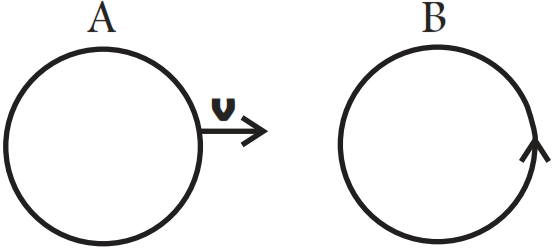
There are two coils A and B as shown in Fig. A current starts flowing in B as shown, when A is moved towards B and stops when A stops moving. The current in A is counterclockwise. B is kept stationary when A moves. We can infer that:

Chadwick was awarded the Nobel Prize in Physics in 1935 for his discovery of:
Two wires A and B are made of same material. The wore A has a length l and diameter r while the wire B has a length 2l and diameter $\frac{\text{r}}{2}$. If the two wires are stretched by the same force, the elongation in A divided by the elongation in 8 is:

  1. $\frac{1}{8}$

  2. $\frac{1}{4}$

  3. $4$

  4. $8$