MCQ
Three rigid rods are joined to form an equilateral triangle $\text{ABC}$ of side $1m.$ Three particles carrying charges $20\mu\text{C}$ each are attached to the vertices of the triangle. The whole system is at rest in an inertial frame. The resultant force on the charged particle at $A$ has the magnitude:
  • Zero
  • B
    $3.6N$
  • C
    $3.6\sqrt{3}\text{N}$
  • D
    $7.2N.$

Answer

Correct option: A.
Zero
Using, $F_{\text {net }}=\mathrm{ma}$,
$a=0 \Rightarrow F_{\text {net }}=0$
As the whole system is at rest, the resultant force on the charged particle at $A$ is zero.

Need a full question paper?

Generate a complete, print-ready paper with questions like this in minutes — across 16+ boards, with answer keys.

Start Generating Free

Similar questions

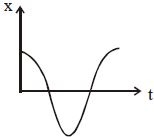
Dispacement time graph of a particle executing $SHM$ is as shown in the figure. Corresponding graph between $PE$ and time is
The mass and volume of a body are found to be $(5.00 ± 0.05)\,kg$ and $(1.00 ± 0.05)\,m^3$ respectively. Then the maximum possible percentage error in its density is .......... $\%$
The molecules of a given mass of a gas have $r.m.s.$ velocity of $200 \,m s^{-1}$ at $27^o C$ and $1.0 \times 10^5 \,Nm^{-2}$ pressure. When the temperature and pressure of the gas are respectively, $127^o C$ and $0.05 \times 10^5 \,Nm^{-2},$ the $r.m.s.$ velocity of its molecules in $m s^{-1}$ is 
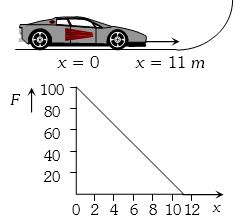
A toy car of mass $5 \,kg$ moves up a ramp under the influence of force  $ F$  plotted against displacement $x$. The maximum height attained is given by
A body of mass $m$ hangs at one end of a string of length $l$, the other end of which is fixed. It is given a horizontal velocity so that the string would just reach where it makes an angle of $60^o$ with the vertical. The tension in the string at mean position is
A closed organ pipe (closed at one end) is excited so as to support the third overtone. It is then found that there are in the pipe:
Two forces are such that the sum of their magnitudes is $18\; N$ and their resultant is $12\; N$ which is perpendicular to the smaller force. Then the magnitudes of the forces are
$50 \,g$ ice at $0^{\circ} C$ is dropped into a calorimeter containing $100 \,g$ water at $30^{\circ} C$. If thermal capacity of calorimeter is zero then amount of ice left in the mixture at equilibrium is .......... $g$
A deep rectangular pond of surface area $A,$ containing water (denstity $=\rho,$ specific heat capactly $=s$ ), is located In a region where the outside air temperature is at a steady value of $-26^{\circ} {C}$. The thickness of the frozen ice layer In this pond, at a certaln Instant Is $x$.

Taking the thermal conductivity of Ice as ${K}$, and its specific latent heat of fusion as $L$, the rate of Increase of the thickness of ice layer, at this instant would be given by 

The moment of inertia of a body depends on