MCQ
Three vectors $\vec{\text{A}},\ \vec{\text{B}}$ and $\vec{\text{C}}$ add up to zero. Find which is false.
  • A
    $(\vec{\text{A}}\times\vec{\text{B}})\times\vec{\text{C}}$ is not zero unless $\vec{\text{B}},\ \vec{\text{C}}$ are parallel.
  • B
    $(\vec{\text{A}}\times\vec{\text{B}}).\vec{\text{C}}$ is not zero unless $\vec{\text{B}},\ \vec{\text{C}}$ are parallel.
  • C
    If $A, B, C$ define a plane, $(\vec{\text{A}}\times\vec{\text{B}})\times\vec{\text{C}}$ is in that plane.
  • Both $A$ and $C$

Answer

Correct option: D.
Both $A$ and $C$
$\vec{\text{A}}+\vec{\text{B}}+\vec{\text{C}}=0$
So $\vec{\text{A}},\ \vec{\text{B}}$ and $\vec{\text{C}}$ are in a plane and can be represented bt the three sides of a triangle taken in order.
$a. \vec{\text{B}}\times(\vec{\text{A}}+\vec{\text{B}}+\vec{\text{C}})=\vec{\text{B}}\times0=0$
$\vec{\text{B}}\times\vec{\text{A}}+\vec{\text{B}}\times\vec{\text{B}}+\vec{\text{B}}\times\vec{\text{C}}=0$
$\vec{\text{B}}\times\vec{\text{A}}+0+\vec{\text{B}}\times\vec{\text{C}}=0$
$\vec{\text{B}}\times\vec{\text{A}}=-\vec{\text{B}}\times\vec{\text{C}}$
$\vec{\text{A}}\times\vec{\text{B}}=\vec{\text{B}}\times\vec{\text{C}}\ \dots(\text{i})$
Or $(\vec{\text{A}}\times\vec{\text{B}})\times\vec{\text{C}}=(\vec{\text{B}}\times\vec{\text{C}})\times\vec{\text{C}}$
$\therefore$ It cannot be zero
$\vec{\text{B}}\times\vec{\text{C}}$ will be zero if $\vec{\text{B}}\times\vec{\text{C}}$ are parallel or antiparallel.
i.e, $(\vec{\text{A}}\times\vec{\text{B}})\times\vec{\text{C}}=[\text{BC}\sin0^\circ]\times\vec{\text{C}}$
$(\vec{\text{A}}\times\vec{\text{B}})\times\vec{\text{C}}=0$ only if $\vec{\text{B}}||\vec{\text{C}}$
Hence option $(a)$ is verified.
$b. (\vec{\text{A}}\times\vec{\text{B}})=\vec{\text{B}}\times\vec{\text{C}} [$from $(i)]$
$(\vec{\text{A}}\times\vec{\text{B}}).\vec{\text{C}}=(\vec{\text{B}}\times\vec{\text{C}}).\vec{\text{C}}$
if $\vec{\text{B}}||\vec{\text{C}}$
$\vec{\text{B}}\times\vec{\text{C}}=\text{BC}\sin0^\circ=0$
$\therefore\ (\vec{\text{A}}\times\vec{\text{B}}).\vec{\text{C}}=0\text{ IF }\vec{\text{B}}||\vec{\text{C}}$
So option $(b)$ is not verified.
$c. (\vec{\text{A}}\times\vec{\text{B}})=\vec{\text{X}}$
The direction of $x$ is perpendicular to both planes containing $A$ and $B.$
$(\vec{\text{A}}\times\vec{\text{B}})\times\vec{\text{C}}=\vec{\text{X}}\times\vec{\text{C}}=\vec{\text{Y}}$
The direction of $\vec{\text{Y}}$ is perpendicular to the plane of $\vec{\text{X}}$ and $\vec{\text{C}}$ which again become in the plane of $\vec{\text{A}},\ \vec{\text{B}},\ \vec{\text{C}}$ but perpendicular to the plane of $\vec{\text{X}}$ and $\vec{\text{C}}.$
Hence option $(c)$ is also verified.
$d. |\text{A}|^2+|\text{B}|^2=|\text{C}|^2$ given
It shows that angle between $\vec{\text{A}}$ and $\vec{\text{B}}$ is $90^\circ$
$=|\text{A}||\text{B}||\text{C}|\cos\theta\neq|\text{A}||\text{B}||\text{C}|$
$(\vec{\text{A}}\times\vec{\text{B}}).\vec{\text{C}}=|\text{A}||\text{B}||\text{C}|\cos\theta$
Does not verified option $(c).$

Need a full question paper?

Generate a complete, print-ready paper with questions like this in minutes — across 16+ boards, with answer keys.

Start Generating Free

Similar questions

A train moving at a speed of $220\, ms^{-1}$ towards a stationary object, emits a sound of frequency $1000\, Hz$. Some of the sound reaching the object gets reflected back to the train as echo. The frequency of the echo as detected by the driver of the train is .... $ Hz$ (speed of sound in air is $330\, ms^{-1}$)
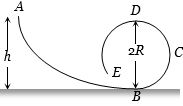
A frictionless track $ABCDE$ ends in a circular loop of radius $R$. A body slides down the track from point $A$ which is at a height $h = 5\, cm$. Maximum value of $R$ for the body to successfully complete the loop is ........... $\mathrm{cm}$
A body of mass $2$ kg is moving on the ground comes to rest after some time. The coefficient of kinetic friction between the body and the ground is $0.2$. The retardation in the body is ...... $m/s^2$ 
Given below are two statements: one is labelled as Assertion $A$ and the other is labelled as Reason $R$

Assertion $A$: Steel is used in the construction of buildings and bridges.

Reason $R:$ Steel is more elastic and its elastic limit is high.

In the light of above statements, choose the most appropriate answer from the options given below

If the body is moving in a circle of radius $ r$ with a constant speed $v$, its angular velocity is
If a cylinder of diameter $1.0\, cm$ at $30°C$ is to be solid into a hole of diameter $0.9997\, cm$ in a steel plate at the same temperature, then minimum required rise in the temperature of the plate is ........ $^oC$ (Coefficient of linear expansion of steel $ = 12 \times {10^{ - 6}}°C^{-1}$)
If time of flight of a projectile is $10$ seconds. Range is $500$ meters. The maximum height attained by it will be  ......... $m$
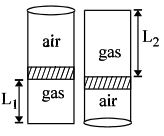
An ideal gas is trapped inside a test tube of cross-sectional area $20 \times 10^{-6} \,\,m^2$ as shown in the figure. The gas occupies a height $L_1$ at the bottom of the tube and is separated from air at atmospheric pressure by a mercury column of mass $0.002\,\, kg$. If the tube is quickly turned isothermally, upside down so that $L_2$ mercury column encloses the gas from below. The gas now occupies height $L_1$ in the tube. The ratio $L_1$ is [Take atmospheric pressure $= 10^5 Nm^{-2}]$ 
A bucket contains water filled upto a height $=$ $15 cm$. The bucket is tied to a rope which is passed over a frictionless light pulley and the other end of the rope is tied to a weight of mass which is half of that of the (bucket $+$ water). The water pressure above atmosphere pressure at the bottom is ....... $kPa$
A cylindrical metallic rod in thermal contact with two reservoirs of heat at its two ends conducts an amount of heat $Q$ in time $t$. The metallic rod is melted and the material is formed into a rod of half the radius of the original rod. What is the amount of heat conducted by the new rod, when placed in thermal contact with the two reservoirs in time $t$ ?