Question
Through what potential difference should an electron be accelerated to give it a speed of: 
  1. 0.6c
  2. 0.9c
  3. 0.99c

Answer

  1. $\text{eV}-\text{m}_0\text{C}^2=\frac{\text{m}_0\text{C}^2}{2\sqrt{1-\frac{\text{V}^2}{\text{C}^2}}}$

$\Rightarrow\text{eV}-9.1\times10^{-31}\times9\times10^{16}$

$=-\frac{9.1\times9\times10^{-31}\times10^{16}}{2\sqrt{1-\frac{0.36\text{C}^2}{\text{C}^2}}}$

$\Rightarrow\text{eV}-9.1\times9\times10^{-15}$

$=\frac{9.1\times9\times10^{-15}}{2\times0.08}$

$\Rightarrow\text{ev}-9.1\times9\times10^{-15}$

$=\frac{9.1\times9\times10^{-15}}{1.6}$

$\Rightarrow\text{eV}=\Big(\frac{9.1\times9}{1.6}+9.1\times9\Big)\times10^{-15}$

$=\text{eV}\Big(\frac{81.9}{1.6}+81.9\Big)\times10^{-15}$

$=\text{eV}=133.0875\times10^{-15}$

$\Rightarrow\text{V}=83.179\times10^{4}=831\text{KV}$

  1. $\text{eV}=\text{m}_0\text{C}^2=\frac{\text{m}_0\text{C}^2}{2\sqrt{1-\frac{\text{V}^2}{\text{C}^2}}}$

$\Rightarrow\text{eV}-9.1\times9\times10^{-19}\times9\times10^{16}$

$=\frac{9.1\times9\times10^{-15}}{2\sqrt{1-\frac{0.81\text{C}^2}{\text{C}^2}}}$

$\Rightarrow\text{eV}-81.9\times10^{-15}=\frac{9.1\times9\times10^{-15}}{2\times0.435}$

$\Rightarrow\text{eV}=12.237\times10^{-15}$

$\Rightarrow\text{V}=\frac{12.237\times10^{-15}}{1.6\times10^{-19}}=76.48\text{kV}$

$\text{V}=0.99\text{C}=\text{ev}-\text{m}_0\text{C}^2=\frac{\text{m}_0\text{C}^2}{2\sqrt{1-\frac{\text{V}^2}{\text{C}^2}}}$

$\Rightarrow\text{eV}=\frac{\text{m}_0\text{C}^2}{2\sqrt{1-\frac{\text{V}^2}{\text{C}^2}}}+\text{m}_0\text{C}^2$

$=\frac{9.1\times10^{31}\times9\times10^{16}}{2\sqrt{1-(0.99)^2}} +9.1\times10^{-31}\times9\times10^{16}$

$\Rightarrow\text{eV}=372.18\times10^{-15}$

$\Rightarrow\text{V}=\frac{372.18\times20^{-15}}{1.6\times10^{-19}}=272.6\times10^{4}$

$\Rightarrow\text{V}=2.726\times10^{6}=2.7\text{MeV}$

Need a full question paper?

Generate a complete, print-ready paper with questions like this in minutes — across 16+ boards, with answer keys.
Start Generating Free

Similar questions

  1. Define viscosity. Write SI units of coefficient of viscosity.
  2. Define terminal velocity. Establish an expression for it.
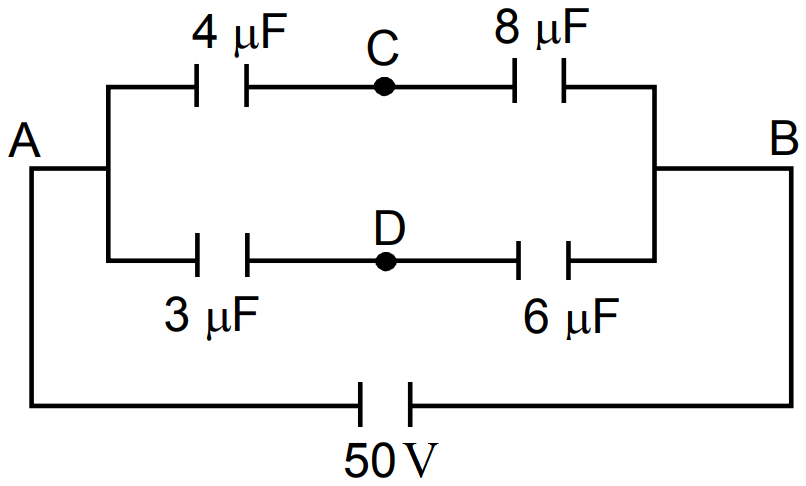
Take the potential of the point B in figure to be zero:
  1. Find the potentials at the points C and D.
  2. If a capacitor is connected between C and D, what charge will appear on this capacitor?

  1. Define mean free path.
  2. Derive an expression for mean free path of a gas molecule.
A famous relation in physics relates ‘moving mass’ m to the ‘rest mass’ mo of a particle in terms of its speed v and the speed of light, c. (This relation first arose as a consequence of special relativity due to Albert Einstein). A boy recalls the relation almost correctly but forgets where to put the constant c. He writes:

$\text{m}=\frac{\text{m}_0}{(1-\text{v}^2)^{1/2}}.$

Guess where to put the missing c.
One end of a long string of linear mass density 8.0 × 10⁻³kg m–1 is connected to an electrically driven tuning fork of frequency 256Hz. The other end passes over a pulley and is tied to a pan containing a mass of 90kg. The pulley end absorbs all the incoming energy so that reflected waves at this end have negligible amplitude. At t = 0, the left end (fork end) of the string x = 0 has zero transverse displacement (y = 0) and is moving along positive y-direction. The amplitude of the wave is 5.0cm. Write down the transverse displacement y as function of x and t that describes the wave on the string.
Write the dimensions and derived units in M.K.S. unit system of the following quantities :
(i) Force, (ii) Power, (iii) Pressure, (iv) Stress, (v) Strain, (vi) Coefficient of elasticity, (vii) Relative density (viii) Gravitational constant.
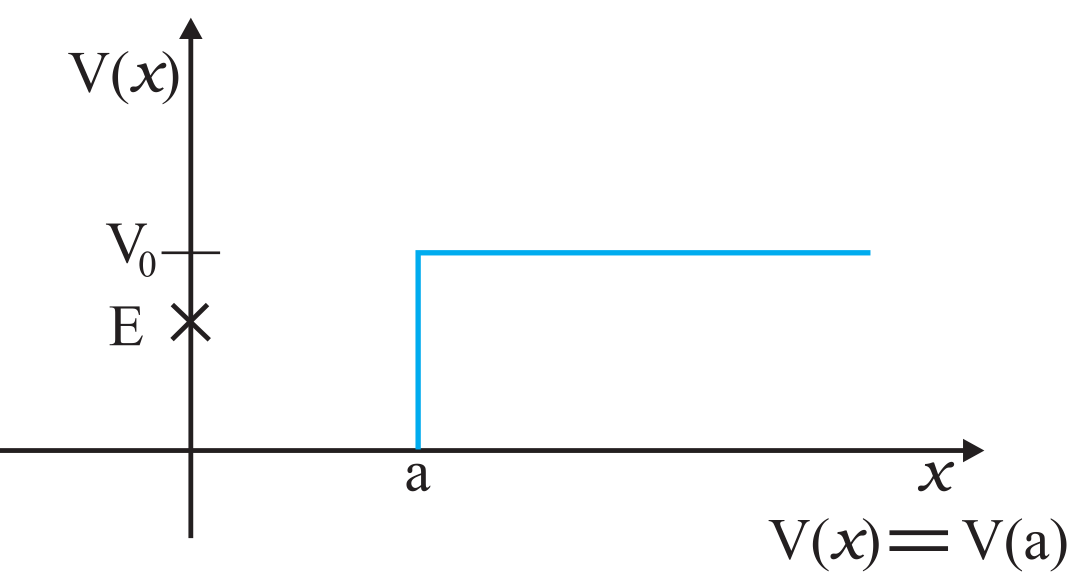
Given in are examples of some potential energy functions in one dimension. The total energy of the particle is indicated by a cross on the ordinate axis. In each case, specify the regions, if any, in which the particle cannot be found for the given energy. Also, indicate the minimum total energy the particle must have in each case. Think of simple physical contexts for which these potential energy shapes are relevan.

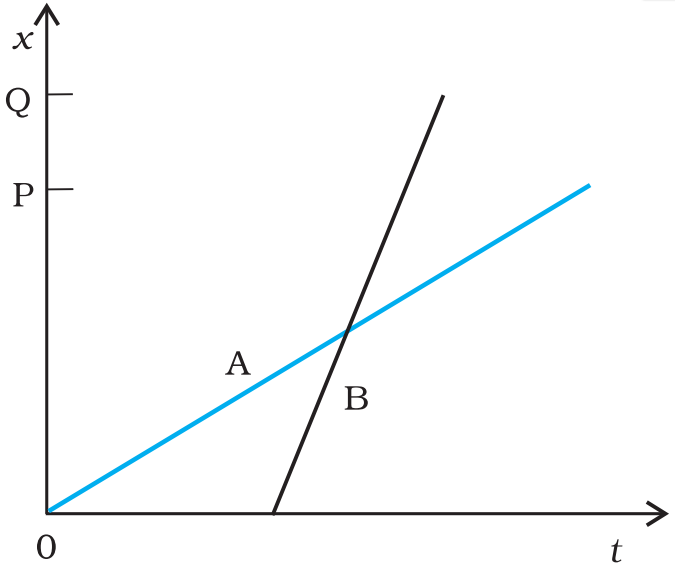
The position-time (x-t) graphs for two children A and B returning from their school O to their homes P and Q respectively are shown in Choose the correct entries in the brackets below;

  1. (A/B) lives closer to the school than (B/A).
  2. (A/B) starts from the school earlier than (B/A).
  3. (A/B) walks faster than (B/A).
  4. A and B reach home at the (same/different) time.
  5. (A/B) overtakes (B/A) on the road (once/twice).

Consider the situation of the previous problem. Suppose each of the blocks is pulled by a constant force F instead of any impulse. Find the maximum elongation that the spring will suffer and the distances moved by the two blocks in the process.
Explain the Newton's law of gravity. Write the value, unit and dimension of universal constant of gravitation. Why is it called universal? Or Write Newton's law of gravity. Define universal gravitational constant (G). Also write its units and dimensional formula.