MCQ
Tincture of iodine is
  • A
    Aqueous solution of $I_2$
  • B
    Solution of $I_2$ in aqueous $KI$
  • Alcoholic solution of $I_2$
  • D
    Aqueous solution of $KI$

Answer

Correct option: C.
Alcoholic solution of $I_2$
c
$KO _{2}, NO _{2}, ClO _{2}, NO$ are paramagnetic.

Need a full question paper?

Generate a complete, print-ready paper with questions like this in minutes — across 16+ boards, with answer keys.
Start Generating Free

Similar questions

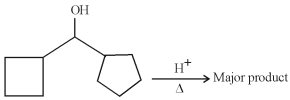
In the above reaction. Left hand side and right hand side rings are named as ' $A$ ' and ' $B$ ' respectively. They undergo ring expansion. The correct statement for this process is:
In infinite dilutions, the equivalent conductances of $B{a^{2 + }}$ and $C{l^ - }$ are $127$  and $76$  $oh{m^{ - 1}}c{m^{ - 1}}$ $eqv{t^{ - 1}}$. The equivalent conductivity of $BaC{l_2}$at indefinite dilution is
For the first order reaction $2 N _2 O _5( g ) \rightarrow 4 NO _2( g )+ O _2( g )$

$(A)$ the concentration of the reactant decreases exponentially with time.

$(B)$ the half-life of the reaction decreases with increasing temperature.

$(C)$ the half-life of the reaction depends on the initial concentration of the reactant

$(D)$ the reaction proceeds to $99.6 \%$ completion in eight half-life duration.

Which of the following polymers are thermoplastic?
$a.$ Teflon.
$b.$ Natural rubber.
$c.$ Neoprene.
$d.$ Polystyrene.
Which of the following is true about freons?
Assertion : On increasing dilution, the specific conductance keep on increasing.

Reason : On increasing dilution, degree of ionisation of weak electrolyte increases and molality of ions also increases.

$P_4 + NaOH + H_2O \to x + y$ the sum of total $P-H$ bonds in $x$ and $y$ ?
The hybridization state of carbon atoms in the product formed by the reaction of ethyl chloride with aqueous potassium hydroxide is
What is true for the equilibrium reaction ?

$\begin{matrix}
   O\,\,\,\,\,\,\,\,\,\,\,\,\,\,\,\,\,\,\,\,\,\,\,\,\,\,\,\,\,\,\,\,\,\,\,\,\,\,\,\,\,\,\,\,\,\,\,  \\
   ||\,\,\,\,\,\,\,\,\,\,\,\,\,\,\,\,\,\,\,\,\,\,\,\,\,\,\,\,\,\,\,\,\,\,\,\,\,\,\,\,\,\,\,\,\,\,\,\,  \\
   C{{H}_{3}}-C-OH+C{{H}_{3}}-OH\overset{cat.}{\longleftrightarrow}  \\
\end{matrix}\begin{matrix}
   O\,\,\,\,\,\,\,\,\,\,\,\,\,\,\,\,\,\,\,\,\,\,\,\,\,\,\,\,\,\,  \\
   ||\,\,\,\,\,\,\,\,\,\,\,\,\,\,\,\,\,\,\,\,\,\,\,\,\,\,\,\,\,  \\
   C{{H}_{3}}-C-O-C{{H}_{3}}+{{H}_{2}}O  \\
\end{matrix}$

The rate of a chemical reaction doubles for every $10\,^o C$ rise of temperature. If the temperature is raised by $50\,^o C,$ the rate of the reaction increases by about  ......... times