MCQ
Tischenko reaction is a modification of
- AAldol condensation
- BClaisen condensation
- ✓Cannizzaro reaction
- DPinacol-pinacolon reaction
In cannizzaro's reaction the base is sodium hydroxide and the oxidation product is a carboxylic acid and the reduction product is an alcohol. 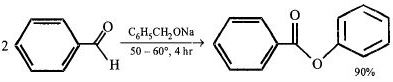
Generate a complete, print-ready paper with questions like this in minutes — across 16+ boards, with answer keys.

The correct statement ($s$) about $P, Q, R$, and $S$ is (are)
($A$) $P$ and $Q$ are monomers of polymers dacron and glyptal, respectively.
($B$) $P, Q$, and $R$ are dicarboxylic acids.
($C$) Compounds $Q$ and $R$ are the same.
($D$) $R$ does not undergo aldol condensation and $S$ does not undergo Cannizzaro reaction.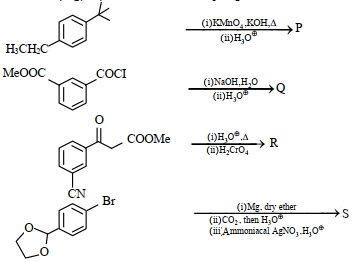
Choose the correct answer from the options given below: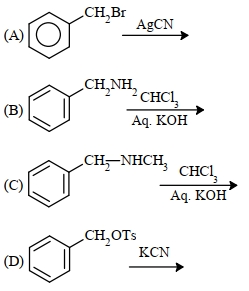
$(1)$ Oxidation of $1-$ phenylethanol
$(2)$ Reaction of benzalthanol with methyl magnesium bromide
$(3)$ Friedel craft’s reaction of benzene with acetyl chloride
$(4)$ Distillation of calcium benzoate
$6 OH ^{-}+ Cl ^{-} \rightarrow ClO _{3}^{-}+3 H _{2} O +6 e ^{-}$
If only $60 \%$ of the current is utilized in the reaction, the time (rounded to the nearest hour) required to produce $10\, g$ of $KCIO _{3}$ using a current of $2\, A$ is..........
(Given : $F =96,500\, C\, mol ^{-1}$ molar mass of $\left. KClO _{3}=122\,gmol ^{-1}\right)$