Question
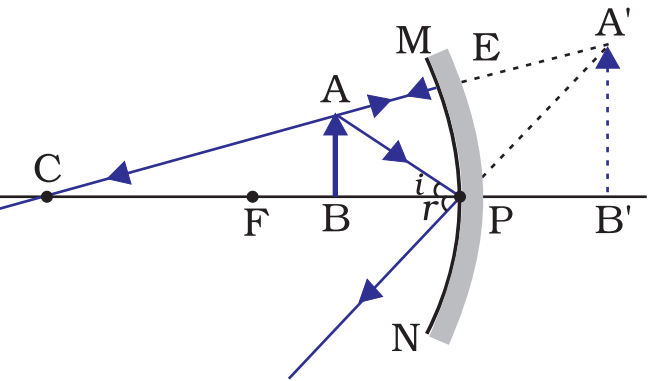
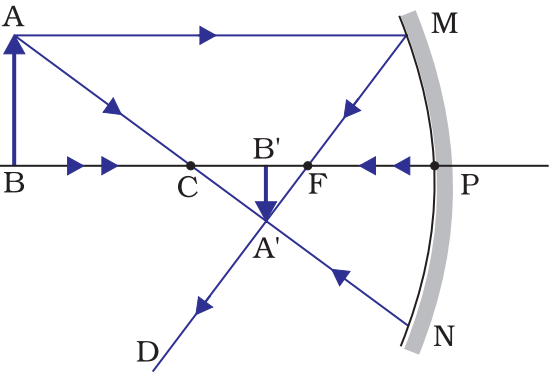
  1. To construct a ray diagram we use two light rays which are so chosen that it is easy to know their directions after reflection from the mirror. List these two rays and state the path of these rays after reflection. Use these two rays to locate the image of an object placed between infinity and the centre of curvature of a concave mirror.
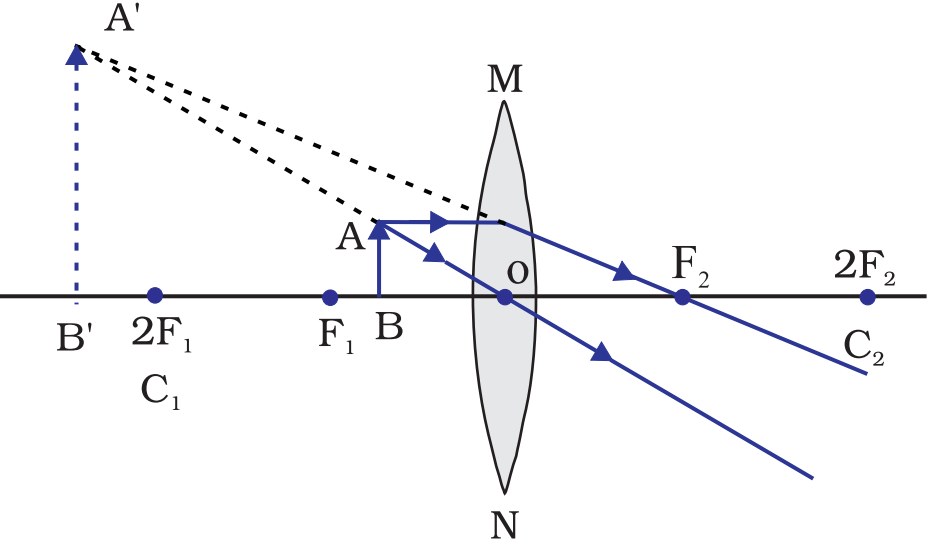
  2. Draw a ray diagram to show the formation of image of an object placed between the pole and principal focus of a concave mirror. How will the nature and size of the image formed change, if the mirror is replaced by a converging lens of same focal length?
Answer

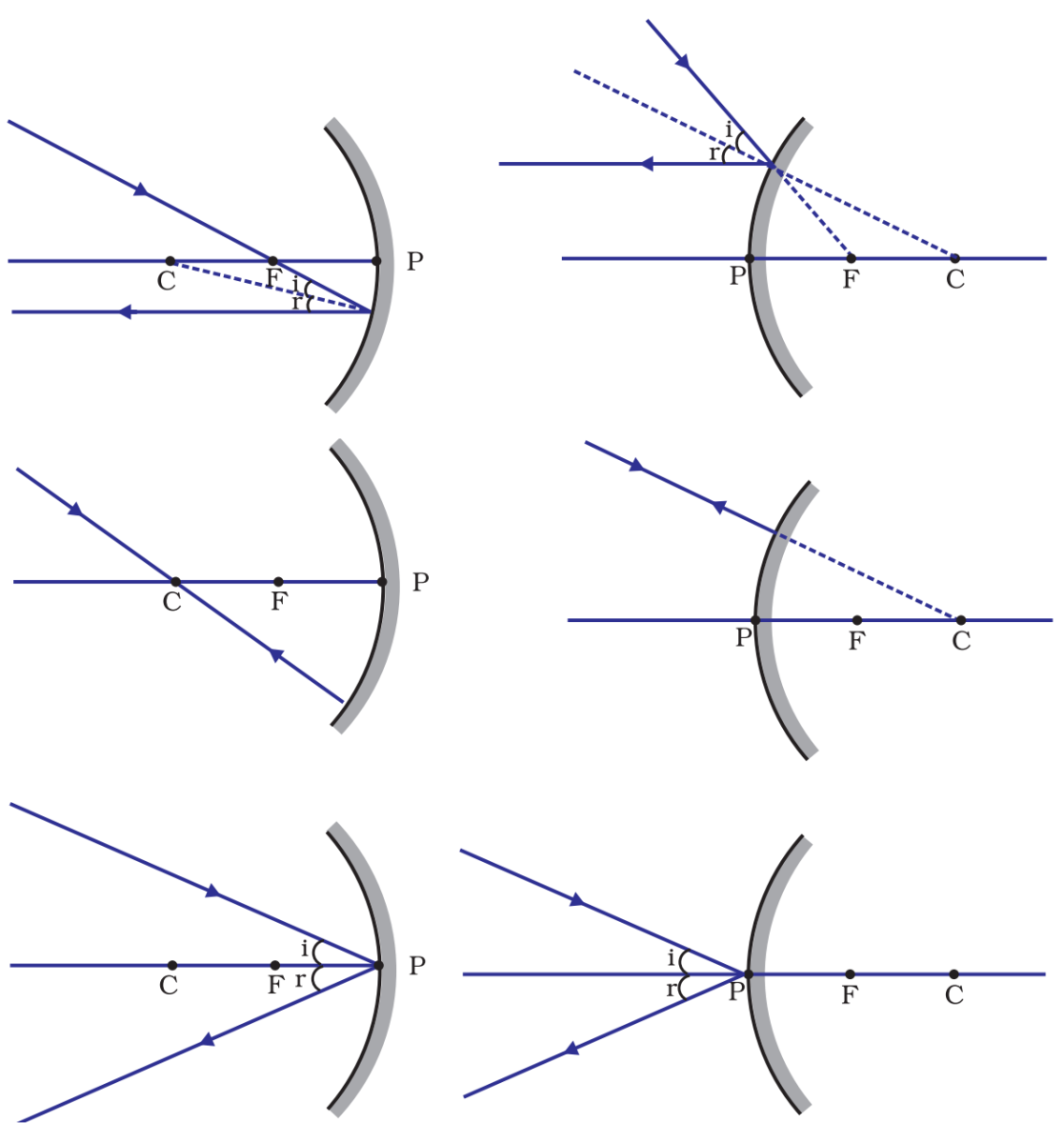
  1. The rays used for obtaining the image from the mirror after reflections are as follows:
  1. A ray which is parallel to the principal axis which on reflecting from the mirror, passes through the focus (when the mirror is concave) or appears to pass through the focus (in case of convex mirror).
  2. A ray which passes through the principal focus of the mirror is directed towards the principal focus , in case of convex mirror, it will emerge as parallel to the principal axis of the mirror.
  3. The Ray which passes through the center of curvature of concave mirror or directed in the direction of center of curvature of convex mirror, reflects back along the same path.
  1. The ray diagrams are as follows:


  1. When object is placed between infinity and C:


  1. When the object is placed between pole and focus of a concave mirror:


  1. When the object is placed between pole and focus of convex lens:

Need a full question paper?

Generate a complete, print-ready paper with questions like this in minutes — across 16+ boards, with answer keys.

Start Generating Free

Similar questions

State the law of refraction of light that defines the refractive index of a medium with respect to the other. Express it mathematically. How is refractive index of any medium 'A' with respect to a medium 'B' related to the speed of propagation of light in two media A and B? State the name of this constant when one medium is vacuum or air.
The refractive indices of glass and water with respect to vacuum are $\frac{3}{2}$ and $\frac{4}{3}$ respectively. If the speed of light in glass is $2\times 10^{8} \text{ m/s}$ find the speed of light in,
  1. Vacuum.
  2. Water.
When a spherical mirror is held towards the sun and its sharp image is formed on a piece of a carbon paper for some time, a hole is burnt in the carbon paper.
  1. What is the nature of spherical mirror?
  2. Why is a hole burnt in the carbon paper?
  3. At which point of the spherical mirror the carbon paper is placed?
  4. What name is given to the distance between spherical mirror and carbon paper?
  5. What is the advantage of using a carbon paper rather than a white paper?
Explain the structure and functioning of Human eye. How are we able to see nearby as well as distant objects?
The descriptions of five kinds of images are given below:
  1. Diminished and virtual.
  2. Enlarged and real.
  3. Enlarged and erect.
  4. Real and inverted.
  5. Virtual and the same size.
Which one of these describes the image formed:
  1. On the retina of the eye?
  2. By a magnifying glass?
  3. By a convex driving mirror on a car?
  4. By a plane mirror?
  5. on the screen of a slide projector?
Describe the construction and working of a biogas plant with the help of a labelled diagram.
The descriptions of five kinds of images are given below:
  1. Diminished and virtual.
  2. Enlarged and real.
  3. Enlarged and erect.
  4. Real and inverted.
  5. Virtual and the same size.
Which one of these describes the image formed:
  1. On the retina of the eye?
  2. By a magnifying glass?
  3. By a convex driving mirror on a car?
  4. By a plane mirror?
  5. on the screen of a slide projector?
For the circuit shown in the diagram given below:

Calculate:
  1. The value of current through each resistor.
  2. The total current in the circuit.
  3. The total effective resistance of the circuit.
Two lamps, one rated 40W at 220V and the other 60W at 220V, are connected in parallel to the electric supply at 220V.
  1. 10 Draw a circuit diagram to show the connections.
  2. Calculate the current drawn from the electric supply.
  3. Calculate the total energy consumed by the two lamps together when they operate for one hour.
The speed of light in vacuum and in two different glasses is given in the table below:
Medium
Speed of light
Vacuum
Flint glass
Crown glass
3.00× 10⁸m/ s
1.86× 10⁸m/ s
1.97× 10⁸m/ s
  1. Calculate the absolute refractive indexes of flint glass and crown glass.
  2. Calculate the relative refractive index for light going from crown glass to flint glass.
A student is unable to see clearly the words written on the blackboard placed at a distance of approximately 4m from him. Name the defect of vision the boy is suffering from. Explain the method of correcting this defect. Draw ray diagram for the:
  1. Defect of vision and also.
  2. For its correction.