Question
To convert a moving coil galvanometer into voltmeter

Answer

(d)a high resistor is needed to join in series

Need a full question paper?

Generate a complete, print-ready paper with questions like this in minutes — across 16+ boards, with answer keys.
Start Generating Free

Similar questions

Which of the following is not an application of eddy currents(a) Induction furnace(b) Galvanometer damping(c) Speedometer of automobiles(d) X-ray crystallography
   
   
The masses of neutron and proton are 1.0087 a.m.u. and 1.0073  a.m.u. respectively. If the neutrons and protons combine to form a helium nucleus (alpha particles) of mass 4.0015 a.m.u. The binding energy of the helium nucleus will be (1 a.m.u.= 931 MeV)(a) 28.4  MeV(b) 20.8  MeV(c) 27.3  MeV(d) 14.2  MeV
       
A bar magnet of length $10 \ cm$ and having the pole strength equal to $10^{-3}$ weber is kept in a magnetic field having magnetic induction $(B)$ equal to $4 \pi \times 10^{-3}$ Tesla. It makes an angle of $30^{\circ}$ with the direction of magnetic induction. The value of the torque acting on the magnet is $\left.\mu_0=4 \pi \times 10^{-7} \text { weber } / \text { amp } \times \mathrm{m}\right)$
de Broglie relation is true  for:
If the current in the circuit for heating the filament is increased, the cutoff wavelength:
The reactance of a circuit is zero. It is possible that the circuit contains:
  1. An inductor and a capacitor.
  2. An inductor but no capacitor.
  3. A capacitor but no inductor.
  4. Neither an inductor nor a capacitor.
Amount of light entering into the camera depends upon(a) Focal length of the objective lens(b) Product of focal length and diameter of the objective lens(c) Distance of the object from camera(d) Aperture setting of the camera


In a semiconductor the separation between conduction band and valence band is of the order of(a) 100 eV(b) 10 eV(c) 1eV    (d) 0 eV
       
A steady current is passing through a linear conductor of non uniform cross-section. The net quantity of charge crossing any cross section per second is:
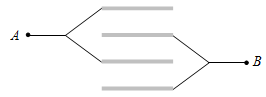
Four plates of the same area of cross$-$section are joined as shown in the figure. The distance between each plate is $d$. The equivalent capacity across $A$ and $B$ will be