Question
To demonstrate the phenomenon of interference, we require two sources which emit radiation(a) Of the same frequency and having a define phase relationship(b) Of nearly the same frequency(c) Of the same frequency (d) Of different wavelengths


Answer

(a) Of the same frequency and having a define phase relationship

Need a full question paper?

Generate a complete, print-ready paper with questions like this in minutes — across 16+ boards, with answer keys.
Start Generating Free

Similar questions

The reading of a high resistance voltmeter when a cell is connected across it is 2.2 V. When the terminals of the cell are also connected to a resistance of 5Ω the voltmeter reading drops to 1.8 V. Find the internal resistance of the cell(a) 1.2 Ω (b) 1.3 Ω (c) 1.1 Ω(d) 1.4 Ω
       
The binding energy of a nucleus is equal to :
A solenoid of length 10cm, diameter 1cm, number of turns 500 with relative permeability of the core 2000, is connected to an ac source of frequency 50 Hz. Then, the reactance is.
The line of force in a magnetic field represents the direction at each point that a magnetic needle placed at the point takes up. Do they also represent the direction of the force on a moving charge at each point?
Assertion :   Mass of ion is slightly differed from its element.
Reason    : Ion is formed, when some electrons are removed or added so mass changes.(a) If both assertion and reason are true and the reason is the correct explanation of the assertion.(b) If both assertion and reason are true but reason is not the correct explanation of the assertion.(c) If assertion is true but reason is false.(d) If the assertion and reason both are false.


Let r be the distance of a point on the axis of a magnetic dipole from its centre. The magnetic field at such a point is proportional to:
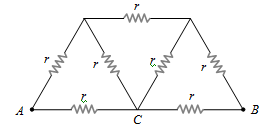
In the circuit shown, the value of each resistance is $r,$ then equivalent resistance of circuit between points $A$ and $B$ will be
Two resistors $R$ and $2R$ are connected in series in an electric circuit. The thermal energy developed in $R$ and $2R$ are in the ratio:
Two conducting circular loops of radii $R_1$ and $R_1$  are placed in the same plane with their centres coinciding. If  $R_1 >> R_1$, the mutual inductance $M$ between them will be directly proportional to
A wave moving in a gas,
  1. Must be longitudinal
  2. May be longitudinal
  3. Must be transverse
  4. May be transverse