To get the maximum current from a parallel combination of $n$ identical cells each of internal resistance $r$ in an external resistance $R$, when
Easy


Download our appand get started for free
Experience the future of education. Simply download our apps or reach out to us for more information. Let's shape the future of learning together!No signup needed.*
Similar Questions
- 1Two wires of same length and thickness having specific resistances $6\, \Omega \,cm$ and $3 \,\Omega\, cm$ respectively are connected in parallel. The effective resistivity is $\rho\, \Omega \,cm$. The value of $\rho$ to the nearest integer, is ..... .View Solution
- 2A current of $1\, mA$ is flowing through a copper wire. How many electrons will pass a given point in one secondView Solution
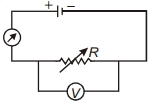
- 3A voltmeter is connected in parallel with a variable resistance $R$ which is in series with an ammeter and a cell as shown in the figure. For one value of $R$, the meters read $0.3 \,A$ and $0.9 \,V$. For another value of $R$ the readings are $0.25 \,A$ and $1.0 \,V$. What is the internal resistance of the cell is ......... $\Omega$View Solution
- 4A wire of length ' $r$ ' and resistance $100 \Omega$ is divided into $10$ equal parts. The first $5$ parts are connected in series while the next $5$ parts are connected in parallel. The two combinations are again connected in series. The resistance of this final combination is:View Solution
- 5Two electric bulbs, rated at $(25\, W, 220\, V)$ and $(100\, W, 220\, V)$, are connected in series acroos a $220\, V$ voltage source. If the $25\, W$ and $100\, W$ bulbs draw powers $P_1$ and $P_2$ respectively, thenView Solution
- 6On interchanging the resistances, the balance point of a meter bridge shifts to the left by $10\ cm$. The resistance of their series combination is $1\ k\Omega$. How much was the resistance on the left slot before interchanging the resistances? .................. $\Omega$View Solution
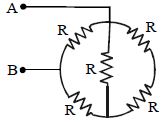
- 7The equivalent resistance between $A$ and $B$ isView Solution
- 8View SolutionThe internal resistance of a cell depends on
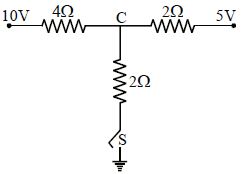
- 9As the switch $S$ is closed in the circuit shown in figure, current passed through it is .............View Solution
- 10If a copper wire is stretched to increase its length by $20 \% $. The percentage increase in resistance of the wire is $..........\%$View Solution