Question
To maintain a rotor at a uniform angular speed of $200rad s^{-1}$, an engine needs to transmit a torque of 180Nm. What is the power required by the engine? (Note: uniform angular velocity in the absence of friction implies zero torque. In practice, applied torque is needed to counter frictional torque). Assume that the engine is 100% efficient.
Answer

Angular speed of the rotor, $\omega=200\text{rad/s}$ Torque required, $\tau=180\text{Nm}$
The power of the rotor (P) is related to torque and angular speed by the relation,
​​​​​​​ $\text{P}=\tau\omega$
$= 180 \times 200 = 36 \times 103 = 36kW$
Hence, the power required by the engine is 36kW.

Need a full question paper?

Generate a complete, print-ready paper with questions like this in minutes — across 16+ boards, with answer keys.

Start Generating Free

Similar questions

A wire of length l carries a current i long the x-axis. A magnetic field exists, which is given $\overrightarrow{\text{B}}=\text{B}_0(\overrightarrow{\text{i}}+\overrightarrow{\text{j}}+\overrightarrow{\text{k}})\text{T}.$ Find the magnitude of the magnetic force acting on the wire.
Characteristic X-rays may be used to identify the element from which they are being emitted. Can continuous X-rays be used for this purpose?
In a Quincke's experiment, the sound intensity has a minimum value $I$ at a particular position. As the sliding tube is pulled out by a distance of $16.5mm,$ the intensity increases to a maximum of $9I.$ Take the speed of sound in air to be $330m/s.$
  1. Find the frequency of the sound source.
  2. Find the ratio of the amplitudes of the two waves arriving at the detector assuming that it does not change much between the positions of minimum intensity and maximum intensity.
To maintain a rotor at a uniform angular speed of $200rad s^{-1}$, an engine needs to transmit a torque of $180Nm$. What is the power required by the engine? (Note: uniform angular velocity in the absence of friction implies zero torque. In practice, applied torque is needed to counter frictional torque). Assume that the engine is 100% efficient.
State law of conservation of momentum and prove it using third law of motion.
The decay constant of ${ }^{238} \mathrm{U}$ is $4.9 \times 10^{-18} \mathrm{~S}^{-1}$.
a. What is the average$-$life of ${ }^{238} \mathrm{U}$ ?
b. What is the half$-$life of ${ }^{238} \mathrm{U}$ ?
c. By what factor does the activity of a ${ }^{238} \mathrm{U}$ sample decrease in $9 \times 10^9$ years?
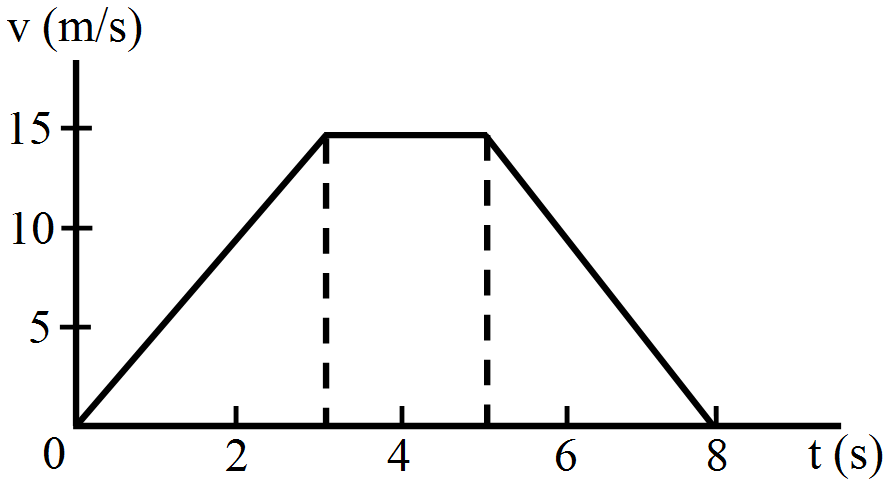
A particle of mass $50g$ moves on a straight line. The variation of speed with time is shown in figure. Find the force acting on the particle at $t = 2, 4$ and $6$ seconds.
  1. Explain the term impulse. Show that impulse of a variable force is equal to the area enclosed by the force-time curve.
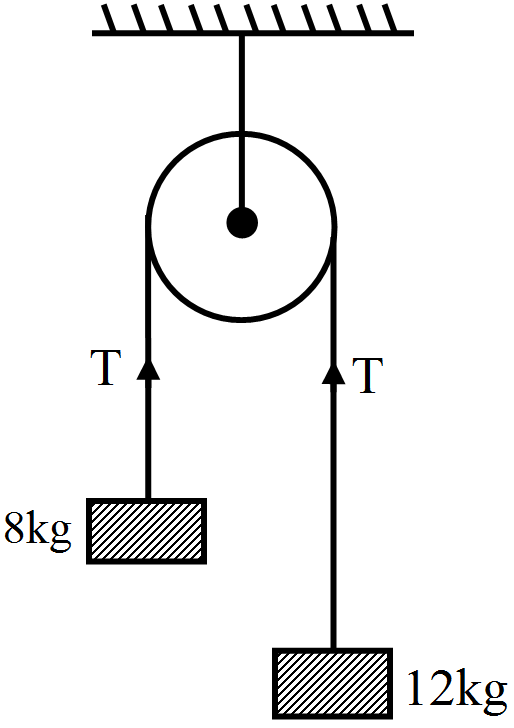
  2. Two masses $8kg$ and $12kg$ are connected at the two ends of a light inextensible string that passes over a frictionless pulley. Find the acceleration of the masses and tension in the string, when the masses are released.
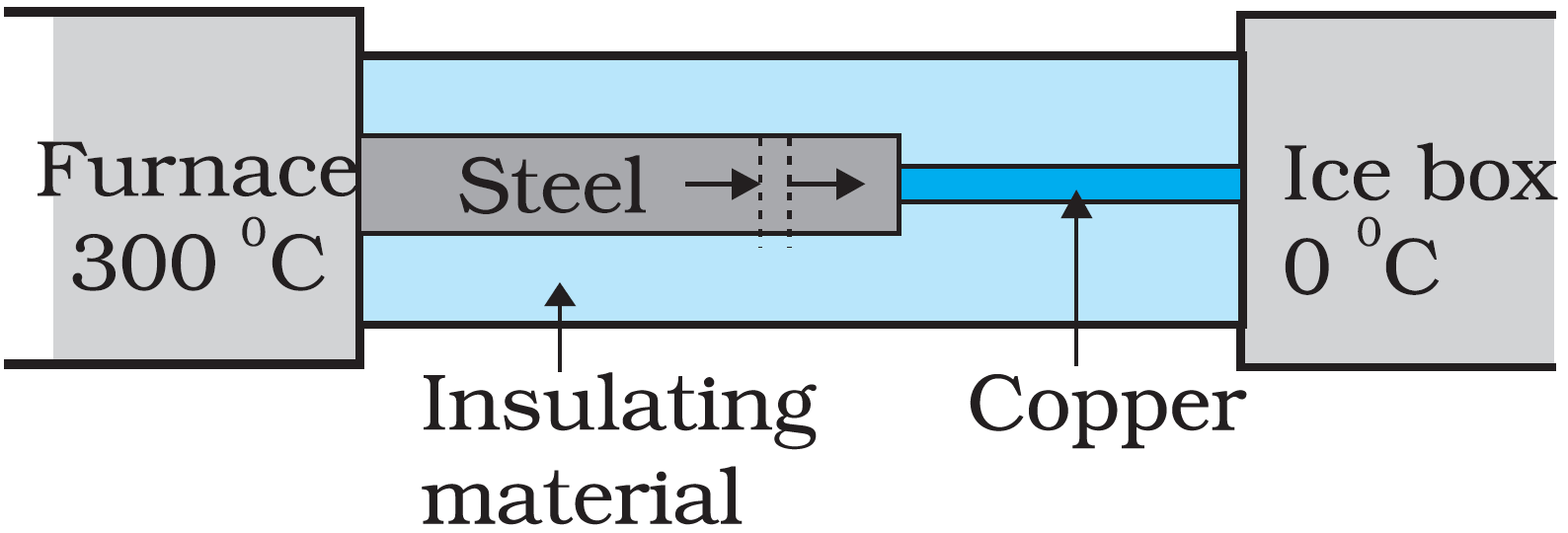
What is the temperature of the steel-copper junction in the steady state of the system shown in the figure. Length of steel rod = $15.0cm$, length of copper rod = $10.0cm$, temperature of the furnace = $300°C$, temperature of the other end = $0°C$. The area of cross-section of steel rod is twice that of copper rod. (Thermal conductivity of steel = $50.2Js^{-1}m^{-1}K^{-1}$ and of copper = $385Js^{-1}m^{-1}K^{-1}$).
Find the angle between force $\vec{\text{F}}=(3\vec{\text{i}}+4\vec{\text{j}}-5\vec{\text{k}})$ unit and displacement $\vec{\text{d}}=(5\vec{\text{i}}+4\vec{\text{j}}+3\vec{\text{k}})$ unit. Also find the projection of $\vec{\text{F}}$ on $\vec{\text{d}}.$