Question
To make P type semiconductor in silicon :

Answer

(b) - Add substances of third group

Need a full question paper?

Generate a complete, print-ready paper with questions like this in minutes — across 16+ boards, with answer keys.
Start Generating Free

Similar questions

6 A particle of charge q and mass m moves rectilinearly under the action of electric field E = A – Bx, where A and B are positive constants and x is distance from the point where particle was initially at rest then the distance travelled by the particle before coming to rest and acceleration of particle at that moment are respectively:
Two capacitances of capacity $C_1$ and $C_2$ are connected in series and potential difference $V$ is applied across it. Then the potential difference across $C_1$ will be
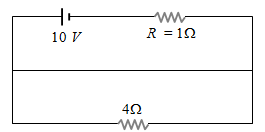
Internal resistance of the cell is:
Free $^{238}U$ nuclei kept in a train emit alpha particles. When the train is stationary and a uranium nucleus decays, a passenger measures that the separation between the alpha particle and the recoiling nucleus becomes $x$ in time $t$ after the decay. If a decay takes place when the train is moving at a uniform speed $v,$ the distance between the alpha particle and the recoiling nucleus at a time $t$ after the decay, as measured by the passenger will be:
A photon with energy twice the work function of the metal is incident on the surface of the metal. The value of maximum kinetic energy of the emitted photoelectron will be :
The motion of a particle is given by $\text{x = A}\sin\omega\text{t+B}\cos\omega\text{t}.$ The motion of the particle is:
  1. Not simple harmonic.
  2. Simple harmonic with amplitude A + B.
  3. Simple harmonic with amplitude $\frac{\text{(A}+\text{B)}}{2}.$
  4. Simple harmonic with amplitude $\sqrt{(\text{A}^2+\text{B}^2)}.$
A dip circle is so set that its needle moves freely in the magnetic meridian. In this position, the angle of dip is 40º. Now the dip circle is rotated so that the plane in which the needle moves makes an angle of 30º with the magnetic meridian. In this position, the needle will dip by an angle:
The internal energy of an ideal gas decreases by the same amount as the work done by the system:
  1. The process must be adiabatic.
  2. The process must be isothermal.
  3. The process must be isobaric.
  4. The temperature must decrease.
A radioactive isotope $X$ with a half-life of $1.37\times 10^9$ years decays to $Y$ which is stable. A sample of rock from the moon was found to contain both the elements $X$ and $Y$ which were in the ratio of $1 : 7.$ The age of the rock is
Potential difference across the terminals of the battery shown in figure is $(r =$ internal resistance of battery$)$