Question
To what angle a cyclist has to bend to negotiate a curved path? Derive an expression.
Answer

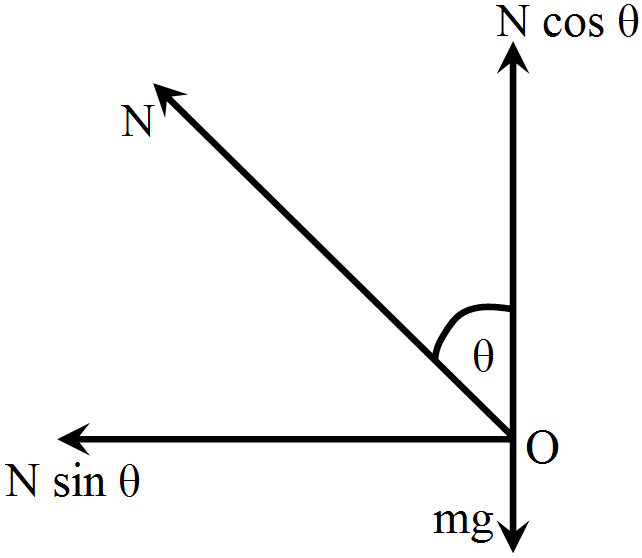
As the cyclist leans by an angle $\theta$ with the vertical, the normal can be acting as shown. If v is the speed of the cyclist, the necessary centripetal force is provided by the component $\text{N}\sin\theta$ of normal reaction and $\text{N}\cos\theta$ provides balancing for weight. $\therefore\ \text{N}\sin\theta=\frac{\text{mv}^2}{\text{r}},$ $\text{N}\cos\theta=\text{mg}$ Dividing, $\tan\theta=\frac{\text{v}^2}{\text{rg}}$ $\Rightarrow\ \theta=\tan^{-1}\Big(\frac{\text{v}^2}{\text{rg}}\Big)$

Need a full question paper?

Generate a complete, print-ready paper with questions like this in minutes — across 16+ boards, with answer keys.

Start Generating Free

Similar questions

The radii of two planets are R and 2R respectively and their densities $\rho\text{ and }\frac{\rho}{2}$ respectively. What is the ratio of acceleration due to gravity at their surfaces?
Two cylinders A and B of equal capacity are connected to each other via a stopcock. A contains a gas at standard temperature and pressure. B is completely evacuated. The entire system is thermally insulated. The stopcock is suddenly opened. Answer the following: Do the intermediate states of the system (before settling to the final equilibrium state) lie on its P-V-T surface?
The friction force of air on an object moving in air is directly proportional to the velocity of the object, what will be the dimension of constant of proportionality (b)?
What is the technique used for measuring large time intervals?
A tuning fork of frequency $440Hz$ is attached to a long string of linear mass density $0.01\ kg/m$ kept under a tension of $49N$. The fork produces transverse waves of amplitude $0.50\ mm$ on the string.
  1. Find the wave speed and the wavelength of the waves.
  2. Find the maximum speed and acceleration of a particle of the string.
  3. At what average rate is the tuning fork transmitting energy to the string?
Explain why Water with detergent disolved in it should have small angles of contact.
Is earth an inertial frame of reference?
A simple microscope is rated 5 for a normal relaxed eye. What will be its magnifying power for a relaxed farsighted eye whose near point is 40cm?
It is a common observation that rain clouds can be at about a kilometre altitude above the ground.
Estimate the time required to flatten the drop.
A rocket with a lift-off mass $20,000 kg$ is blasted upwards with an initial acceleration of $5.0 ms^{-2}$. Calculate the initial thrust (force) of the blast.