MCQ
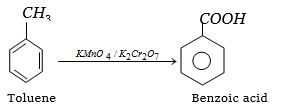
Toluene is oxidised to benzoic acid by
  • A
    $KMn{O_4}$
  • B
    ${K_2}C{r_2}{O_7}$
  • C
    ${H_2}S{O_4}$
  • Both (a) and (b)

Answer

Correct option: D.
Both (a) and (b)
d
(d)

Need a full question paper?

Generate a complete, print-ready paper with questions like this in minutes — across 16+ boards, with answer keys.

Start Generating Free

Similar questions

In the following sequence of the reations, what is $D$?

(image) $\xrightarrow{{[O]}}A\xrightarrow{{SOC{l_2}}}B\xrightarrow{{Na{N_3}}}C\xrightarrow{{Heat}}D$
$pH$ of a $0.1\, M$ monobasic acid is measured to be $2$. Its osmotic pressure at a given temperature $T$ $K$ is
The order and molecular number of reaction of $CH _3 COOC _2 H _5+ H _2 O \xrightarrow{ H ^{+}} CH _3 COOH +$ $C _2 H _5 OH$ are respectively
$\alpha$ - helix is found in
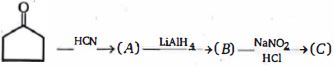
End product $(C)$ in above, reaction is
The rate constant for the reaction, $2{N_2}{O_5} \to 4N{O_2}$ $ + {O_2}$ is $3 \times {10^{ - 5}}{\sec ^{ - 1}}$. If the rate is $2.40 \times {10^{ - 5}}\,mol\,\,litr{e^{{\rm{ - 1}}}}{\sec ^{ - 1}}$. Then the concentration of ${N_2}{O_5}$ (in mol litre $^{-1}$) is
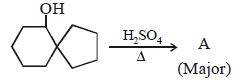
Major product $A$ is 
When a metal rod ${M}$ is dipped into an aqueous colourless concentrated solution of compound ${N}$, the solution turns light blue. Addition of aqueous $\mathrm{NaCl}$ to the blue solution gives a white precipitate ${O}$. Addition of aqueous $\mathrm{NH}_3$ dissolves ${O}$ and gives an intense blue solution.

$1.$ The metal rod ${M}$ is

$(A)$ $\mathrm{Fe}$ $(B)$ $\mathrm{Cu}$ $(C)$ $\mathrm{Ni}$ $(D)$ $\mathrm{Co}$

$2.$ The compound ${N}$ is

$(A)$ $\mathrm{AgNO}_3$ $(B)$ $\mathrm{Zn}\left(\mathrm{NO}_3\right)_2$

$(C)$ $\mathrm{Al}\left(\mathrm{NO}_3\right)_3$ $(D)$ $\mathrm{Pb}\left(\mathrm{NO}_3\right)_2$

$3.$ The final solution contains

$(A)$ $\left[\mathrm{Pb}\left(\mathrm{NH}_3\right)_4\right]^{2+}$ and $\left[\mathrm{CoCl}_4\right]^{2-}$

$(B)$ $\left[\mathrm{Al}\left(\mathrm{NH}_3\right)_4\right]^{3+}$ and $\left[\mathrm{Cu}\left(\mathrm{NH}_3\right)_4\right]^{2+}$

$(C)$ $\left[\mathrm{Ag}\left(\mathrm{NH}_3\right)_2\right]^{+}$and $\left[\mathrm{Cu}\left(\mathrm{NH}_3\right)_4\right]^{2+}$

$(D)$ $\left[\mathrm{Ag}\left(\mathrm{NH}_3\right)_2\right]^{+}$and $\left[\mathrm{Ni}\left(\mathrm{NH}_3\right)_6\right]^{2+}$

Give the answer question $1,2$ and $3.$

In a reaction $A_2B_3(g) \to A_2(g) + \frac{3}{2}B_2(g)$, the pressure increases from $60$ torr to $75$  torr in $2.5\, minutes$. The rate of disappearance of $A_2B_3$ is ........ $torr\, min^{-1}$
The decreasing order of reactivity of $m-$ nitrobromobenzene $(I), 2, 4, 6-$ trinitrobromo-benzene $(II), p-$ nitrobromobenzene $(III)$, and $2,4-$ dinitrobromobenzene $(IV),$ towards $OH^-$ ions is