MCQ
Total number of stereo isomers possible by given compound is
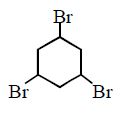
  • $2$
  • B
    $3$
  • C
    $4$
  • D
    $8$

Answer

Correct option: A.
$2$
a

Need a full question paper?

Generate a complete, print-ready paper with questions like this in minutes — across 16+ boards, with answer keys.

Start Generating Free

Similar questions

In acidic medium $Mn{{\overset{\Theta }{\mathop{O}}\,}_{4}}$ is an oxidising agent $Mn{{\overset{\Theta }{\mathop{O}}\,}_{4}}+8\overset{\oplus }{\mathop{H}}\,+5{{e}^{-}}\to M{{n}^{+2}}+4{{H}_{2}}O$ 

If $\mathop H\limits^ \oplus  $ ion concentration is doubled, electrode potential of the half cell will

(image) $\xrightarrow{{B{r_2}/hv}}$ $\mathop {Major}\limits_{\left( X \right)} \xrightarrow[{KOH/\Delta }]{{Alcoholic}}\mathop {Major}\limits_{\left( Y \right)} $$\xrightarrow[{Peroxide}]{{H - Br}}\mathop {Major}\limits_{\left( Z \right)} $

Major final product $(Z)$ is

Name the hydrocarbon that is a liquid at  $STP$
The reference electrode is made from which of the following
A metal surface is exposed to $500\, \mathrm{~nm}$ radiation. The threshold frequency of the metal for photoelectric current is $4.3 \times 10^{14}\, \mathrm{~Hz}$. The velocity of ejected electron is $.......\,\times 10^{5} \mathrm{~ms}^{-1}$ (Nearest integer)

[Use : $\left.\mathrm{h}=6.63 \times 10^{-34}\, \mathrm{Js}, \mathrm{m}_{\mathrm{e}}=9.0 \times 10^{-31}\, \mathrm{~kg}\right]$

Solubility product of silver bromide is $5.0 \times 10^{-13}.$ The quantity of potassium bromide (molar mass taken as $120\, g\,mol^{-1}$) to be added to $1$ litre of $0.05\, M$ solution of silver nitrate to start the precipitation of $AgBr$ is
Which of the following resonating structures of $1-$methoxy$-1, 3-$butadiene is least stable
A mixture of $H_2$ and sufficient quantity of air at $25\,^oC$ aild $1\ atm$ pressure undergoes complete combustion in a closed rigid adiabatic container leaving behind $H_2O(g)$ and $N_2(g)$. If air is a mixture of $80\% N_2$ and $20\%O_2$ by volume and $C_{P(N_2 )}$ and $C_{P(H_2O)g}$ are $7.0$ and $8.0\  cal-deg^{- 1}\  mol^{-1}$ respectively. What will be max imum temperature attained ?

( Given that : ${\left( {\Delta {H^o}_f} \right)_{{H_2}O(g)}} =  - 56.0\,\,kcal/mol$ and it is independnet of temperature).......$ K$ 

For a zero order reaction. Which of the following statement is false
Which of the following statement is wrong