Question
Trace the evolution of the United Nations since its establishment in 1945. How does it function with the help of its various structures and agencies?

Answer

  1. Evolution of UN since 1945:
  • The UN was founded as a successor to the League of Nations. It was established in 1945 immediately after the Second World War.
  • The organisation was set up through the signing of the United Nations Charter by 51 states.
  • The UN’s objective is to prevent international conflict and to facilitate cooperation among states. It was founded with the hope that it would act to stop the conflicts between states, escalating into war and if war broke out, to limit the extent of hostilities.
  • The UN was intended to bring countries together to improve the prospects of social and economic development all over the world.
  1. Functioning of UN:
  • He UN consists of many different structures and agencies.
  • War and peace and differences between member states are discussed in the General Assembly as well as the Security Council.T
  • Social and economic issues are dealt with by many agencies including the WHO, UNDP, UNHCR, UNHRC, UNICEF, UNESCO, among others.

Need a full question paper?

Generate a complete, print-ready paper with questions like this in minutes — across 16+ boards, with answer keys.
Start Generating Free

Similar questions

Explain any three lessons learnt from the emergency imposed in 1975.
Analyse India‘s stand on environmental issues.
How far is it correct to say the international alliances during the Cold War era were determined by the requirements of the superpowers and the calculations of the smaller states? Explain.
Explain India’s stand on environmental issues.
Analyse the issue ‘Indira vs the Syndicate’. What type of challenges did the issue pose before Indira Gandhi?
Why did India and China both view themselves as rising powers in global politics in-spite of tension between them? Substantiate your answer by giving any four events that have brought cordiality in their relationship.
Read the passage given below and answer the following questions:
The interim government took a firm stance against the possible division of India into smaller principalities of different sizes. The Muslim League opposed the Indian National Congress and took the view that the States should be free to adopt any course they liked. Sardar Patel, India's Deputy Prime Minister and the Home Minister during the crucial period, immediately after Independence, played a historic role in negotiating with the rulers of Princely States in bringing most of them into the Indian Union.
  1. Which government has been referred to as the interim government?
  2. Why did the Muslim League oppose the Indian National Congress?
  3. What makes the role of Sardar Patel a historic one? Explain.
Describe any three effects of globalisation on the culture of a country.
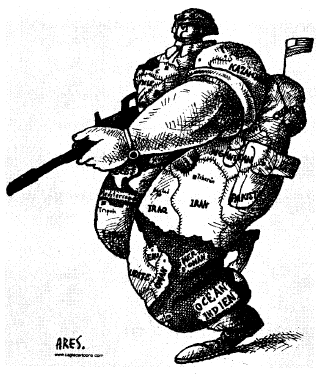
Study the cartoon given below carefully and answer the questions that follow:
  1. The mighty soldier with weapons represents which country?
  2. Why do names of various countries appear on his uniform?
  3. What important message does the cartoon convey to the World?
Explain the vision of the ASEAN for 2020.