Question
Trace the origin and evolution of Man.

Answer

Evolution of Man:
S. NO
Human Ancestors
Time of Origin
General FeaturesGeneral Features
(i)
Dryopithecus
25 mya
Ape-like, hairy, arms and legs of same length, large brain, ate soft fruits and leaves, walked like gorillas and chimpanzees.
(ii)
Ramapithecus
15 mya
More man-like, walked more erect, teeth like modern man.
(iii)
Australopithecus
2 mya
Fossils found in Tanzania and Ethiopia, man-like primates, 4 feet tall, walked upright, ate fruit, hunted with stone weapons, brain capacity was 400–600 cc.
(iv)
Homo habilis
2 mya
Fossils found in East Africa, first human-like being, brain
capacity 650–800 cc, did not eat meat.
(v)
Homo erectus(Java man)
1.5 mya
Fossils found in Java, brain capacity 900 cc, ate meat.
(vi)
Homo sapiensneanderthalensis(Neanderthal man)
100,000 - 40,000year ago
Fossils found in east and central Asia, brain size 1400 cc, used hides to protect body, buried their dead.
(vii)
Homo sapiens(Modern man)
75,000 - 10,000years ago
Developed cave art, agriculture, started human civilisation.

Need a full question paper?

Generate a complete, print-ready paper with questions like this in minutes — across 16+ boards, with answer keys.
Start Generating Free

Similar questions

Suggest some methods to assist infertile couples to have children.
Why is thermoregulation more effectively achieved in larger animals than in smaller ones?
Draw a labelled schematic structure of a transcription unit. Explain the function of each component in the unit in the process of transcription.
Explain the principle of insertional inactivation by giving a suitable example.
Answer the following questions:
Differentiate between gametogenesis in human males and females on the basis of:
  1. Time of initiation of the process.
  2. Products formed at the end of the process.
Differentiate between homology and analogy. Also discuss the homologous and vestigeal organs with example and how do they explain the evidence of evolution.
Who revealed biochemical nature of the transforming principle? How was it done?
Explain a monohybrid cross taking seed coat colour as a trait in Pisum sativum. Work out the cross up to F2 generation.
  1. How did Hardy-Weinberg explain that allelic frequencies in a population are stable and are constant from generation to generation?
  2. Why does genetic equilibrium get disturbed in a population? Give reasons.
Read the following and answer any four questions from (i) to (v) given below:

Gene therapy is the technique of genetic engineering to replace a faulty gene by a normal healthy functional gene. It is a way of treating genetic disease by introducing a piece of DNA into the cells of an affected individual. Liposomes can be used for gene therapy as they target the cells affected by a genetic disease.

  1. A patient suffers from adenosine deaminase (ADA) deficiency, an autosomal recessive immune deficiency in which bone marrow lymphoblasts cannot replicate to generate immuno-competent lymphocytes. The treatment option that would cure the patient is:
  1. Germ-line gene therapy to replace one ADA gene copy.
  2. Germ-line gene therapy to replace both ADA gene copies.
  3. Somatic cell gene therapy to replace both ADA gene copies in circulating lymphocytes.
  4. Somatic cell gene therapy to replace one ADA gene copy in bone marrow lymphoblasts.
  1. Which type of gene therapy is least effective in transferring DNA to the nucleus?
  1. Adenoviruses.
  2. DNA attached to a ligand.
  3. Liposomes.
  4. Retroviruses.
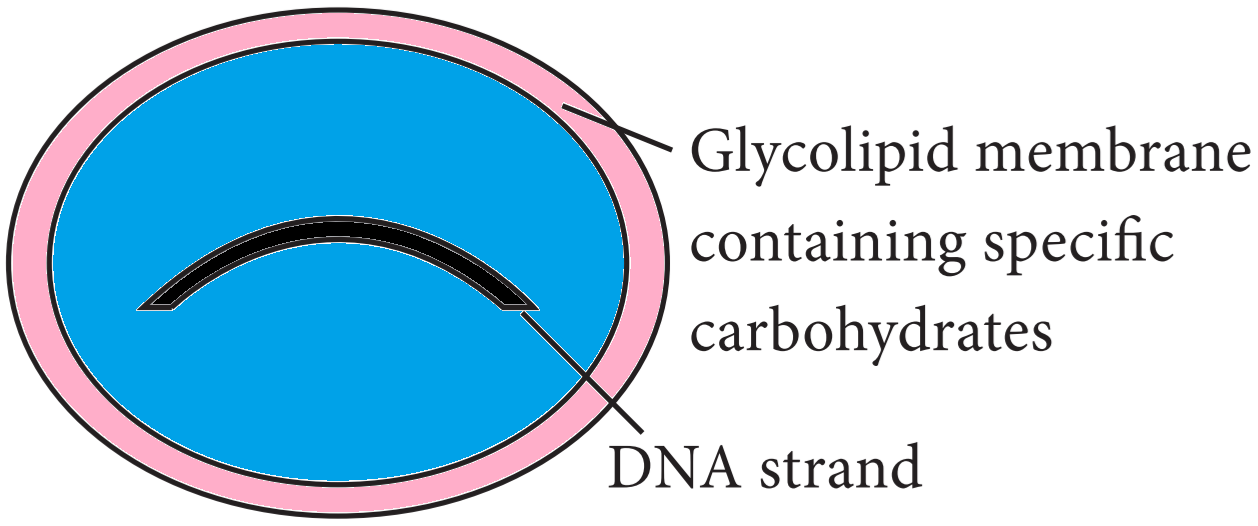
  1. Liposomes can be used for gene therapy as they target the cells affected by a genetic disease. The diagram shows the structure of a liposome.

What feature of a cell surface membrane allows the liposome to target cells affected by a genetic disease? 

  1. Carrier molecules.
  2. Phosphate groups.
  3. Protein channels.
  4. Receptor molecules.
  1. Which of the following disorders would gene therapy be least effective?
  1. Cystic fibrosis.
  2. Huntington's disease.
  3. Sickle cell anaemia.
  4. Type II diabetes.
  1. Following are some reasons explaining why gene therapy is not yet fully an effective treatment for genetic diseases.
  1. Lack of knowledge of DNA sequences.
  2. Lack of efficient and safe gene delivery system.
  3. Cost of the technology.
  4. Some diseases involve multiple genes.
  5. Problems with appropriate gene regulation.

Select the correct option. 

  1. I, III and V only
  2. II, IV and V only
  3. Ill, IV and V only
  4. I, III and IV only