Question
Transition elements show high melting points. Why?

Answer

The high melting points of transition metals are due to strong metallic bonds between the atoms of these elements This is because of involvements of a greater number of electrons in the interatomic metallic bonding from (n-1)d orbitals in addition to ns electrons in the interatomic molecular bonding.

Need a full question paper?

Generate a complete, print-ready paper with questions like this in minutes — across 16+ boards, with answer keys.
Start Generating Free

Similar questions

The treatment of alkyl chlorides with aqueous KOH leads to the formation of alcohols but in the presence of alcoholic KOH, alkenes are major products. Explain.
Explain the following terms with suitable example:
(i) Molarity
(ii) Molality
Answer the following:
(a) Define rate of reaction?
(b) For a reaction the rate law expression is represented as follows:
Rate $=k[A][B]^{\frac{1}{2}}$
   i. Interpret whether the reaction is elementary or complex. Give reason to support your answer.
  ii. Write the unit of rate constant for this reaction if concentration of A and B is expressed in moles/L
Note: In the following questions a statement of assertion followed by a statement of reason is given. Choose the correct answer out of the following choices.
  1. Both assertion and reason are true and the reason is the correct explanation of assertion.
  2. Both assertion and reason are true and the reason is not the correct explanation of assertion.
  3. Assertion is true but the reason is false.
  4. Both assertion and reason are false.
  5. Assertion is false but reason is true.
Assertion: Electrolysis of NaCl solution gives chlorine at anode instead of O2.
Reason: Formation of oxygen at anode requires overvoltage.
Low level of noradrenaline is the cause of depression. What type of drugs are needed to cure this problem? Name two drugs.
How will you bring the following conversions?
Phenol to m-bromophenol.
Write the reaction of $t$-butyl methyl ether with conc. HI and also explain its mechanism.
Following data are obtained for the reaction:
N2O5 $\rightarrow$ 2NO2 + ½O2
t/s 0 300 600
[N2O5]/mol L–1 1.6 × 10⁻² 0.8 × 10⁻² 0.4 × 10⁻²
  1. Show that it follows first order reaction.
  2. Calculate the half-life.
(Given log 2 = 0.3010 log 4 = 0.6021)
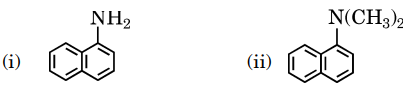
Classify the following amines as primary, secondary and tertiary :
Image
(iii) $\left( C _2 H _5\right)_2 CHNH _2$
(iv) $\left( C _2 H _5\right)_2 NH$
Explain physical properties of transition elements.